Harvest festivals celebrated more than finished work for the season; they celebrated the capacity to survive the winter. The best known of these harvest festivals was the Eleusinian Mysteries, a weeklong celebration in ancient Greece that fell close to the Autumn Equinox. The equinox is not just a one-day event It can happen over a span of two to three...
The Daily Mail published an article related to one of the Maier files backstories. An unusual collection of books on witches as well as the occult that was collected by SS chief Heinrich Himmler in the war has actually been found in the Czech Republic. The books – part of a 13,000-strong collection – were discovered in a depot of...
Heretic Middle English: from Old French heretique, via ecclesiastical Latin from Greek hairetikos ‘able to choose’ (in ecclesiastical Greek, ‘heretical’), from haireomai ‘choose’. In the Encyclopaedia Britannica one can read:“The word heresy is derived from the Greek hairesis which originally meant an act of choosing, and so came to signify a set of philosophical opinions or the school professing them. As so used the term was neutral, but once appropriated by Christianity it began to convey a note of disapproval. […]...
Holle the goddesses and Yule. Frau Holle is connected to springs, wells and lakes, where she lives in a land on the bottom of the water. She is also connected with the fog. Holle can be seen as a bright shape drifting in the fog, and her fog maidens are “die Hollen”, who move over the land to come to...
Hella, Hel, known to all Germanic peoples, including the Goths as Hellarunester. A Gothic word for “witch” was Haljoruna. The name itself stems from a root meaning “to hide”. The word Hellirunar describes people who ‘rune’ (Speak, sing, whisper) with Hel/Helja, the goddess and realm of the underworld. “Hell”, in its original meaning is the hidden realm, the dark and...
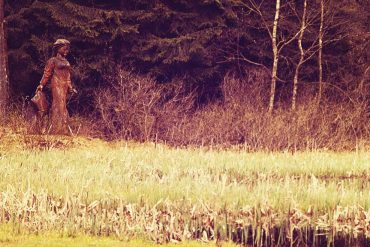
Tidbits on the tale of Frau Holle’s kitzen. There is a mountain in Hessen, Germany called the Meissner where one still can find traces of the central German goddess Holle, Holda or Helja. It’s a place where her cult seems to have survived for a long time. There are roads going to the mountaintop and there are many hiking paths. Close to the top is the Frau Holle Teich, a small lake fed by mountain springs. Only a few centuries […]...
Meister Eckhart (the thirtheenth-century German mystic) once said, “if you fight your death, you’ll feel the demons tearing away your life, but, if you have the right attitude to death, you will be able to see that the devils are really angels setting your spirit free. In the ancient belief systems, the being who guides the human spirit through the...
772 AD. A military campaign pauses. Charlemagne’s army doesn’t press the advantage — it tears down a wooden post. Why? You don’t stop a war to demolish something unless that something is the war. The Column That Carries Heaven Around 850 AD, the monk Rudolf of Fulda wrote down what the Saxons had believed before the conquest. He described a...
Envision for a minute that there is a Very High and amazingly old Civilization. It has achieved the summit of its social and logical accomplishment. At that point, in an erupsion of frenzy and greed, it destroys itself in a Great War. As the untold annihilation achieves its peak and the colossal complexity of its science and innovation — the very science and innovation it has used to wage its war — can never again be maintained because of the […]...
Grimm writes that the Hörselberg of Thuringia was still considered in the 10th through 14th centuries to be the residence of the German goddess Holda and her host. He cited legends of night-women in the service of dame Holda. Those women rove through the air on appointed nights, mounted on beasts. He asserted that they were originally dæmonic elvish beings,...
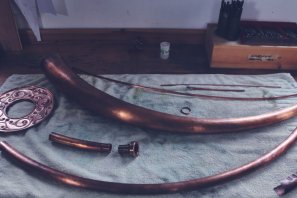
John Kenny ‘s fascinating CD “Dragon Voices.Around 1990, John Purser – composer, musicologist, poet, playwright, broadcaster and passionate scholar of Scotland’s music – initiated a project to reconstruct the so-called Deskford carnyx, which was discovered in a peat bog at Leitchestown farm in Deskford, in the former Scottish county of Banffshire, in 1816. Only the boar’s-head bell survives, apparently placed...
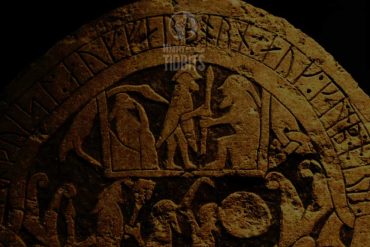
The music of Jón Leifs is often inspired by Iceland’s powerful nature and literary heritage. From early on he was profoundly influenced by the medieval tradition of Icelandic literature, preserved in a handful of manuscripts, including the Poetic Edda and the Prose Edda. Leifs’ magnum opus is the Edda oratorio, a massive (although incomplete) work in three large parts which occupied him on and off for most of his composing career – from around 1930 to his death in 1968. […]...