
The Outer Court — First Degree
“The Blue Degrees are but the outer court or portico of the Temple.” — Albert Pike, Morals and Dogma (1871), p. 819
In April 1946, in Geneva, thirty-five of the forty-six remaining members of the League of Nations gathered for the last time. They had come to vote the institution out of existence. The French delegate, Joseph Paul-Boncour, offered the League a kind of epitaph: it had not failed, he said; the nations had neglected it. The vote was taken. The buildings, the library and the other assets passed to a successor that had already been in existence for six months, and that was about to receive a plot of land on the East River in New York.
A house for all the nations would need furnishing. The nations obliged.
⬥
The Gift
On 4 December 1959 the Soviet Deputy Foreign Minister, Vassily Kuznetsov, presented the United Nations with a bronze figure by the sculptor Evgeniy Vuchetich. A muscular man raises a hammer over a sword and bends it into a ploughshare. The title is taken from the prophet Isaiah.
The Secretary-General, Dag Hammarskjöld, accepted it on the organisation’s behalf. The statue still stands in the north garden.
The words of a Hebrew prophet, cast in bronze, were handed over by a state that had made atheism its official doctrine, and received into a building that belongs to no faith at all. No one at the ceremony appears to have found this remarkable. Perhaps it wasn’t. In a house of this kind, a prophecy can be accepted as a gift without anyone being asked to believe it.
⬥
The Room
Hammarskjöld had a room of his own in mind.
A small space for silent reflection had existed at headquarters since 1952. Under his personal supervision it was rebuilt and reopened in 1957. He chose its contents himself.
The room narrows as it runs toward its far wall. There hangs an abstract fresco by the Swedish painter Bo Beskow: geometric planes in blue, white, yellow and grey. In the centre stands a block of polished iron ore weighing some six tons, a gift of the King of Sweden and a Swedish mining company. A single beam of light falls on it from the ceiling. There is nothing else.
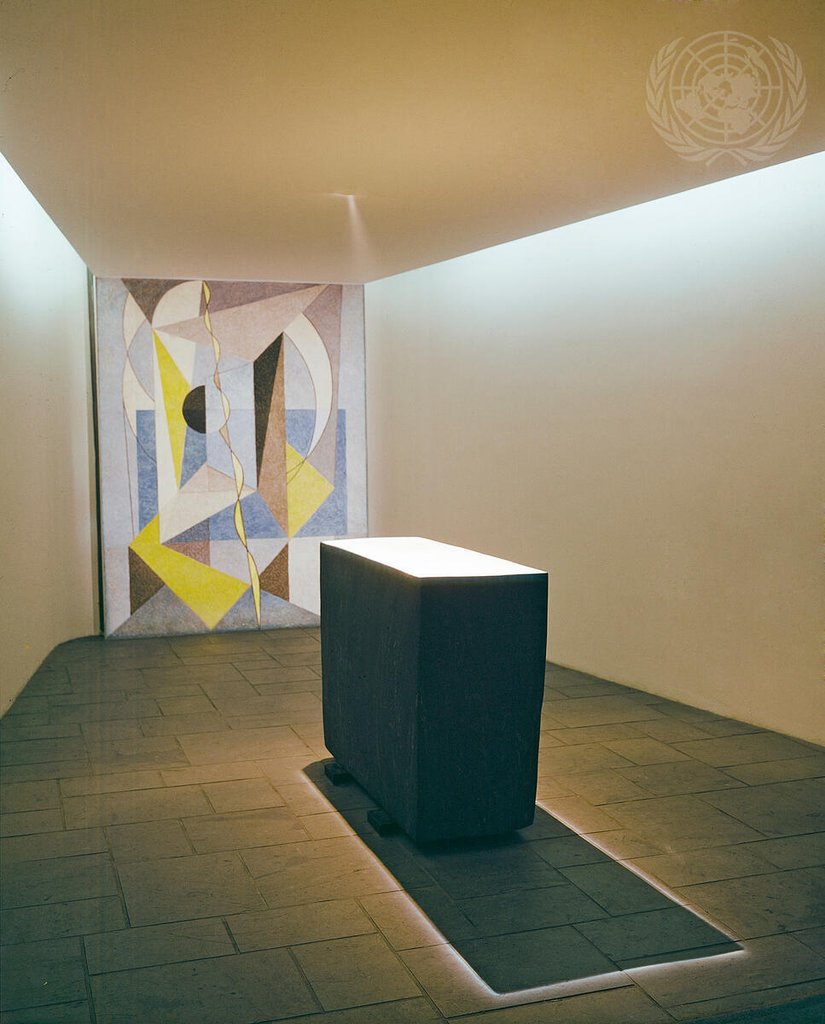
Hammarskjöld wrote a short text for visitors. People of many faiths would meet in this room, he explained, and for that reason none of the symbols they were accustomed to could be used. He described the iron as an image of what is firm and permanent in a world of movement and change.
Then he said what the stone was.
It could be seen as an altar, he wrote. It was empty, but not because there is no God, and not because it was an altar to an unknown god. It was empty because it was dedicated to “the God whom man worships under many names and in many forms.”
It is a precise sentence, and Hammarskjöld was a precise man. He does not say the gods. He does not say every god. He speaks of one God, the same one, who is known under many names. The altar does not have to decide between those names, because the room has already decided that they all refer to the same being.
It is not the first time a city has housed a god in a stone without an image. In 204 BC Rome fetched a dark stone from Pessinus in Asia Minor. The Romans received it as the Great Mother of the gods herself, not as a likeness of her, and in time gave it a temple on the Palatine.
⬥
The Window
Hammarskjöld died in September 1961, when his aircraft came down in Northern Rhodesia on its way to peace talks over the Congo. Fifteen others died with him.
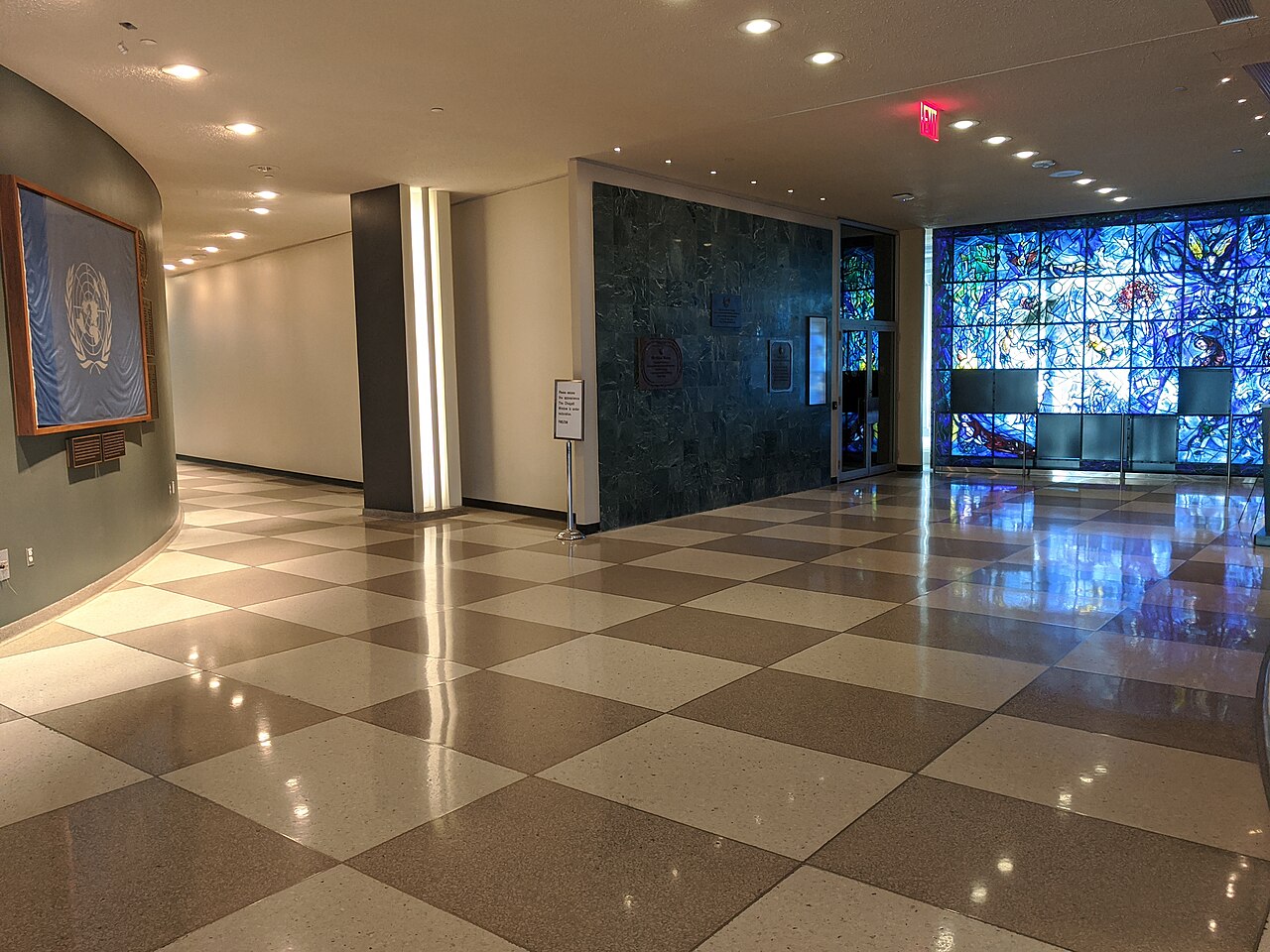
Three years later, on 17 September 1964, the staff of the United Nations and the painter Marc Chagall presented a memorial window to the building. It is a stained-glass panel some fifteen feet wide. A tree of paradise divides it. On one side, human and animal figures float as if weightless. On the other, figures gather around a cross. Serpents coil along the bottom. At the top are the tablets of the law.
So the same house now holds both kinds of room. In one there is a cross, the serpent and the commandments, the old symbols in their proper places. In the other there is a stone from which every symbol has been carefully removed, so that no one would feel excluded. The window remembers the man who built the room. The room has no memory of anything.
On the organised shaping of public opinion, see Hypnosis in Advertising and Politics.
⬥
The Neighbour
In May 1922 a publishing company was registered in New Jersey. Its first task was to publish a book by Alice Bailey called Initiation, Human and Solar. The company was called the Lucifer Publishing Company. By its own later account, the name honoured a journal that Helena Blavatsky, the founder of Theosophy, had edited for some years. By the same account, the name was changed in 1924, once it became clear that some Christians associated Lucifer with Satan. It has been the Lucis Trust ever since.
The Lucis Trust has held consultative status on the roster of the United Nations Economic and Social Council since 1989. Its affiliate, World Goodwill, is recognised as a non-governmental organisation by the UN’s Department of Global Communications. The Trust states that its New York office overlooks the United Nations.
None of this is hidden. It is written on the Trust’s own website, in its own words.
⬥
What Remains
Everything described here can be visited, photographed and looked up: the statue in the garden, the window, the stone in the quiet room. Each came with a donor’s name and a date, and each was accepted with thanks. Nothing had to be smuggled in.
The League of Nations was built as a secular institution, and so was its successor. In its most private room, however, the successor’s second Secretary-General set up an altar. He wrote down whom it served, and he removed from it every sign by which an ordinary believer might recognise his own faith.
An empty altar is still an altar. An altar that belongs to every name belongs, in the end, to whoever decides what the names mean.
Who decided, in that room, what the names mean?
The Outer Court is a series in degrees. Next: Which Is to Be Master.
