
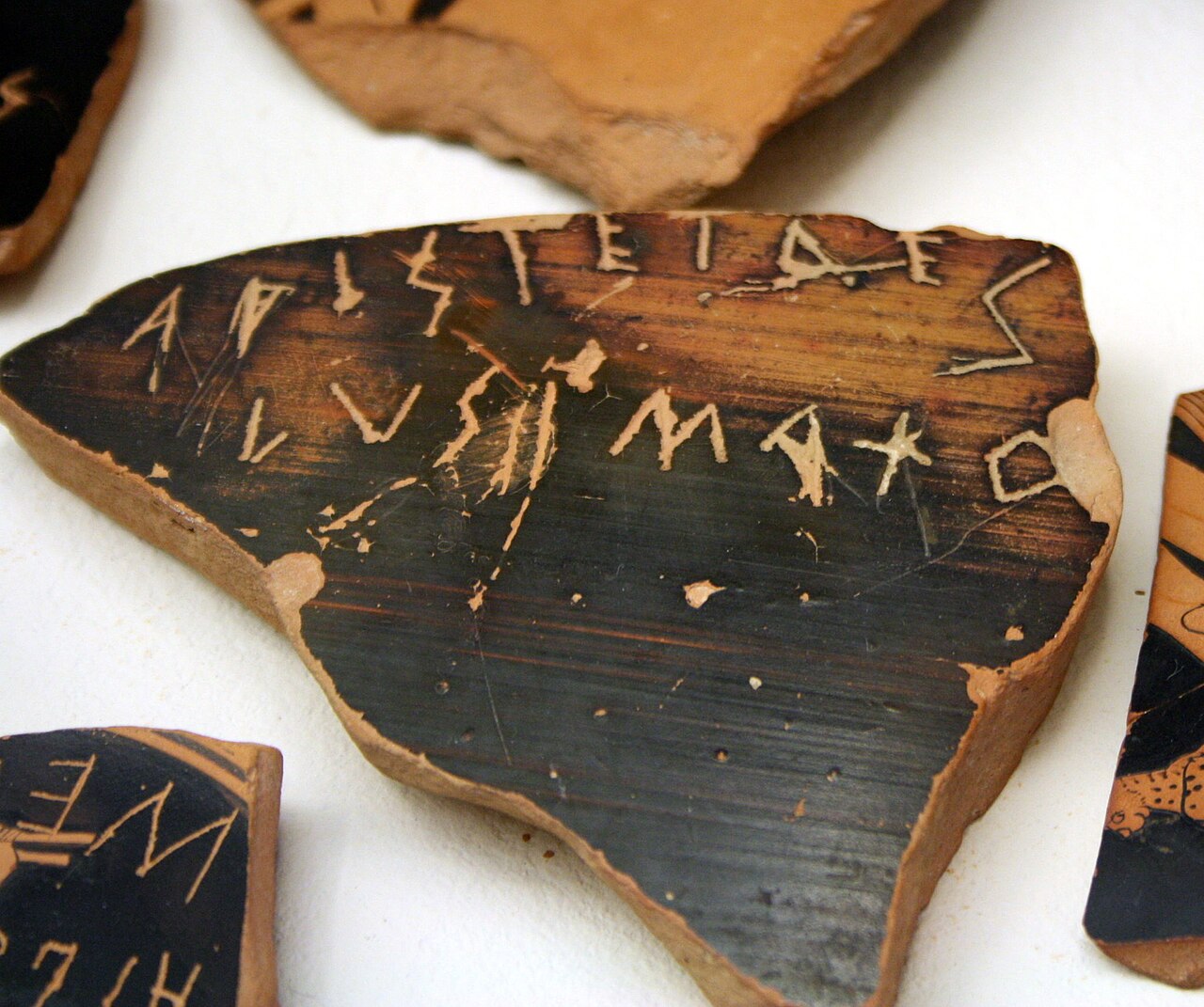
In 482 BC, or perhaps a year or two earlier, for the sources do not agree, the citizens of Athens came in from the farms and villages of Attica to the agora, each with a piece of broken pottery in his hand. The shard was a ballot. On it a man scratched the name of the fellow citizen he wished to see gone from the city for ten years, and he dropped it into an enclosure fenced off with railings, where the magistrates would count.
One of the voters could not write. Plutarch, who tells the story some six centuries later and introduces it with the careful words it is said, calls him unlettered and thoroughly boorish. He turned to the man beside him, whom he took for an ordinary citizen like himself, and asked him to write a name on the shard for him: Aristides.
The man asked what wrong Aristides had ever done him. None whatever, came the answer. He did not even know the fellow. He was simply tired of hearing him called the Just wherever he went.
The stranger made no reply. He took the shard, wrote his own name on it, and handed it back.
⬥ ⬥ ⬥
A Vote Without a Crime
Ostracism was not a trial. There was no charge, no accuser who had to prove anything, and no defence, because there was nothing to defend against. The magistrates first counted the shards; if fewer than six thousand had been cast, the vote was void. Otherwise the names were sorted into heaps, and the man with the largest heap had ten days to leave Attica. He kept his property and its income, and after ten years he could come home without disgrace. If he came back early, the penalty was death. The procedure had been devised, so the tradition went, to keep the friends of the old tyrants from returning, and its first victim was not sent away until 487 BC.
Aristides was no tyrant’s friend. He had been archon, the highest office in the city, in 489, and by most accounts he had fought at Marathon the year before. His surname was the trouble. Plutarch says the Athenians loved him for it at first and then came to resent it, especially after his great rival Themistocles set it about among the people that Aristides was settling disputes privately, doing away with the public courts, and making himself a monarch in all but the bodyguard. The city, flushed with its victory over the Persians, had begun to think nothing too good for itself, and to be vexed with anyone who towered above the rest in name and reputation.
Plutarch’s own judgment is short. The Athenians, he writes, gave their envy the name of fear of tyranny. Ostracism was called a humbling of oppressive power, but it was in truth a way of letting jealous hatred vent itself in something milder than ruin: a mere change of residence for ten years. Nearly two and a half thousand years later the American sociologist David Riesman, reading the same century, saw in it an institution designed against tyrants that had turned into a weapon of public opinion, used to cut down to size the statesmen, playwrights and orators of markedly superior ability.
⬥ ⬥ ⬥
The Prayer
When he left the city, Aristides is said to have lifted his hands to heaven and prayed. Plutarch notes that it was the opposite of the prayer of Achilles in the first book of the Iliad, who asked that his people be made to suffer until they remembered what they owed him. Aristides asked that no crisis might ever come upon the Athenians that would force them to remember Aristides.
The crisis came in the third year. In 480 BC the Persian king Xerxes was marching through Thessaly and Boeotia toward Attica, and Athens voted to let its ostracised men come home. Plutarch is plain about the reason. It was not regret. The Athenians were afraid that Aristides, nursing his grievance abroad, would go over to the enemy and take others with him. They had, Plutarch adds, badly misjudged the man.
On the eve of Salamis the Greek fleet lay in the narrows, its commanders still arguing about withdrawing, and nobody aboard knew that the Persian ships had closed the strait behind them during the night. Aristides did. He came across from Aegina in the dark, through the enemy’s lines, went straight to the tent of Themistocles, the man who had helped send him away, and called him out alone. He offered to set their quarrel aside and serve as his counsellor, since Themistocles alone, he said, had seen that the battle had to be fought there and then. Themistocles answered that he would not have wished to be outdone by Aristides in this, and would try to match him in deeds.
The Greeks won at Salamis. The following year Aristides commanded the Athenians at Plataea. Herodotus, writing within living memory of these events and five centuries before Plutarch, had already given his own verdict: of all the Athenians, Aristides had been the best and the most just.
⬥ ⬥ ⬥
The Shards in the Well
The same pottery found its way to Themistocles. The victor of Salamis, the man who had built the fleet that saved the city, was himself ostracised, around 471 BC at the latest, and ended his days in the service of the Persian king whose father he had beaten. Aristides lived to see it. By the ancient accounts, he showed his old rival nothing but generosity.
The shards themselves survive by the thousand. The American excavators of the Athenian agora have catalogued more than eleven hundred of them, names scratched by many hands over the course of the fifth century. In 1937 the archaeologist Oscar Broneer found something stranger in a well on the north slope of the Acropolis: one hundred and ninety-one ostraka thrown in together, nearly every one bearing the same name, Themistocles. Broneer himself asked in print which of the votes against Themistocles they belonged to. Whether they were ever dropped into the enclosure at all, or how so many of them came to lie together at the bottom of a well, the shards do not say.
⬥ ⬥ ⬥
The Last Vote
For another sixty years the shards kept falling, on great men and, increasingly, on lesser ones. The end came in 416 or 415 BC, at the height of the war with Sparta. The two most powerful men in Athens were Nicias, cautious and rich, and Alcibiades, young, brilliant and reckless, and they were at odds over everything. When an ostracism was called, it was clear to the whole city that one of the two would be sent away. A third man, the popular speaker Hyperbolus, is said to have pressed for the vote in the hope of seeing one of them go.
The two rivals did not wait for the count. They came to terms with each other, combined their followings, and turned the shards on Hyperbolus. He was the one who left. Some years later he was murdered on Samos.
Plutarch tells what the Athenians did next. They felt that the institution had been insulted and degraded, and they abandoned it altogether. No law ever abolished ostracism; it was simply never used again. A modern historian, P. J. Rhodes, offers a drier explanation, that the procedure had always been too blunt an instrument, and that from about this time the Athenians were turning to more precise ways of calling their office-holders to account. Both may be true. The shard that was meant to keep the powerful in check had, in the end, been picked up by the powerful themselves, and it was the people who put it down.
⬥ ⬥ ⬥
Modern historians are not sure the voter who could not write ever existed. Plutarch heard the story centuries after the fact and told it as hearsay, and one historian has called it an edifying tale while questioning how readily his colleagues have accepted it as true. Perhaps it is only a parable the Athenians told about themselves.
Yet the end of the story needs no parable. It rests on the record: a city that once let envy wear the mask of vigilance, and that, when it finally saw two great men turn its own vote into their instrument, was disgusted enough to put the shards away for good. The Athenians, it seems, could still be ashamed of what had been done in their name.
How would a city know, from the inside, the day it no longer could?
