
On 21 March 1493, in the market and mining town of St. Leonhard in the upper Lavant valley of Carinthia, the district court recorded what three women had said under torture. The record names them as Cristina Trünkhlin, Barbara Ößlin, and a third woman called only Wolfin. According to the confession, the three had worked harmful magic against the lord of the local castle, Wolfgang von Pain, and had done so in league with the devil. The court sentenced all three to death. Others in the valley were accused in the months that followed, and how many of them died is not known. The researchers who transcribed the record regard it as the first case on the soil of present-day Austria in which the charge of a pact with the devil ended in executions.
⬥
A Word for Agreement
The confession turns on a single sentence: “Da sie nu beieinander gewesen sein, da sind sie überains worden”, or “when they had been together, they came to an agreement.”
Überein werden was the ordinary speech of the valley. Neighbours used it when they settled the price of a cow, the terms of a marriage, or the line of a boundary. English has no single word for it; “to come to one accord” is the nearest. In the record the phrase carried more weight than that. An agreement among three women became a contract with a fourth party who was not in the room.
The learned doctrine of the witch trials held that harmful magic needed a pact, and a pact needed parties who had agreed. The court at St. Leonhard did not have to prove the devil. It needed only to record the word.
⬥
The Landlord in Franconia
The town that recorded this confession did not answer to a lord in Carinthia. Around the year 1007, Emperor Henry II gave the see of Bamberg a block of estates in the south: the country around Villach, the Canal valley, and the Lavant valley around Wolfsberg. St. Leonhard itself had grown up around a church consecrated by a bishop of Bamberg. As early as 1325 it received a mining ordinance from another.
From the fourteenth century onward, Bamberg governed these lands through a Vizedom, a deputy drawn from its own cathedral chapter and seated at Wolfsberg. He controlled the bishop’s manors, granaries, tolls and forests. The revenue came from the ground: iron in the upper valley, lead and mercury near Villach. The lord of the Lavant valley lived more than four hundred kilometres to the north-west and was entitled to its income without having to see it.
Sovereignty was another matter. Bamberg and the Habsburg dukes of Carinthia disputed it for generations. In 1535 Bamberg ceded supreme jurisdiction, taxation and military command to Austria for a hundred and one years, but kept its dues, its tolls and its mines. In 1674 sovereignty passed to the Habsburgs for good. In 1759 the last Bamberg rights in Carinthia were sold to the Austrian state under Maria Theresa.
Who held the power of life and death over the court at St. Leonhard in 1493 is exactly the kind of question the two powers were still arguing forty years later. The three women were not asked for their opinion on it.
⬥
A Doctrine in Search of a Court
Eight years earlier and some two hundred kilometres to the west, the same doctrine had been put to a court and had failed. In 1485 the Dominican inquisitor Heinrich Kramer opened a witch trial in Innsbruck. The proceedings collapsed under the objections of local clergy and lawyers, and the bishop of Brixen, Georg Golser, saw to it that the inquisitor left his diocese. Within two years Kramer had his theory in print as the Malleus Maleficarum, the Witches’ Hammer. In the book he did not need a bishop’s permission.
One of the Carinthian researchers has described the St. Leonhard case as the first successful application of that book’s doctrine on Austrian soil. Whether the court in the Lavant valley had read the Hammer, or had only absorbed what the Hammer taught, the record does not say. What separates Innsbruck from St. Leonhard is not the accused. It is the bench.
⬥
The Long Pause
The valley then went quiet for a hundred years. The great waves of persecution reached Carinthia only in the century after 1493. From the middle of the seventeenth century, executions came in waves and one trial led to the next. The surviving records for the province show about a hundred and forty proceedings connected with witchcraft, some two hundred and fifty people accused, and about a hundred and ten executed. For the Lavant valley itself, research as it stood in 1987 counted eleven proceedings between the fifteenth and eighteenth centuries.
The victims also changed. In the first phase, the courts of the valley mostly prosecuted settled women with homes and neighbours. From 1650 onwards they increasingly turned to men, and above all to vagrants with no fixed abode, who were treated as a threat to public order. Across Carinthia as a whole, two thirds of those accused of witchcraft were men. The early trials settled quarrels between neighbours; the later ones settled questions of order. A vagrant, by definition, had no household to vouch for him.
The last witch trial in the Lavant valley was held in 1725, at St. Leonhard, where the first had been.
⬥
Paid by the Case
In Bamberg itself the machinery ran at a scale the valley never reached. In the prince-bishoprics of Bamberg and Würzburg, the final great wave of persecution killed between nine hundred and twelve hundred people in each territory. It was not the first wave. Between 1616 and 1619, a hundred and fifty-five people were burned in the Bamberg territory, more than four fifths of them women. By the account of a Bamberg local historian, that wave ended for financial reasons.
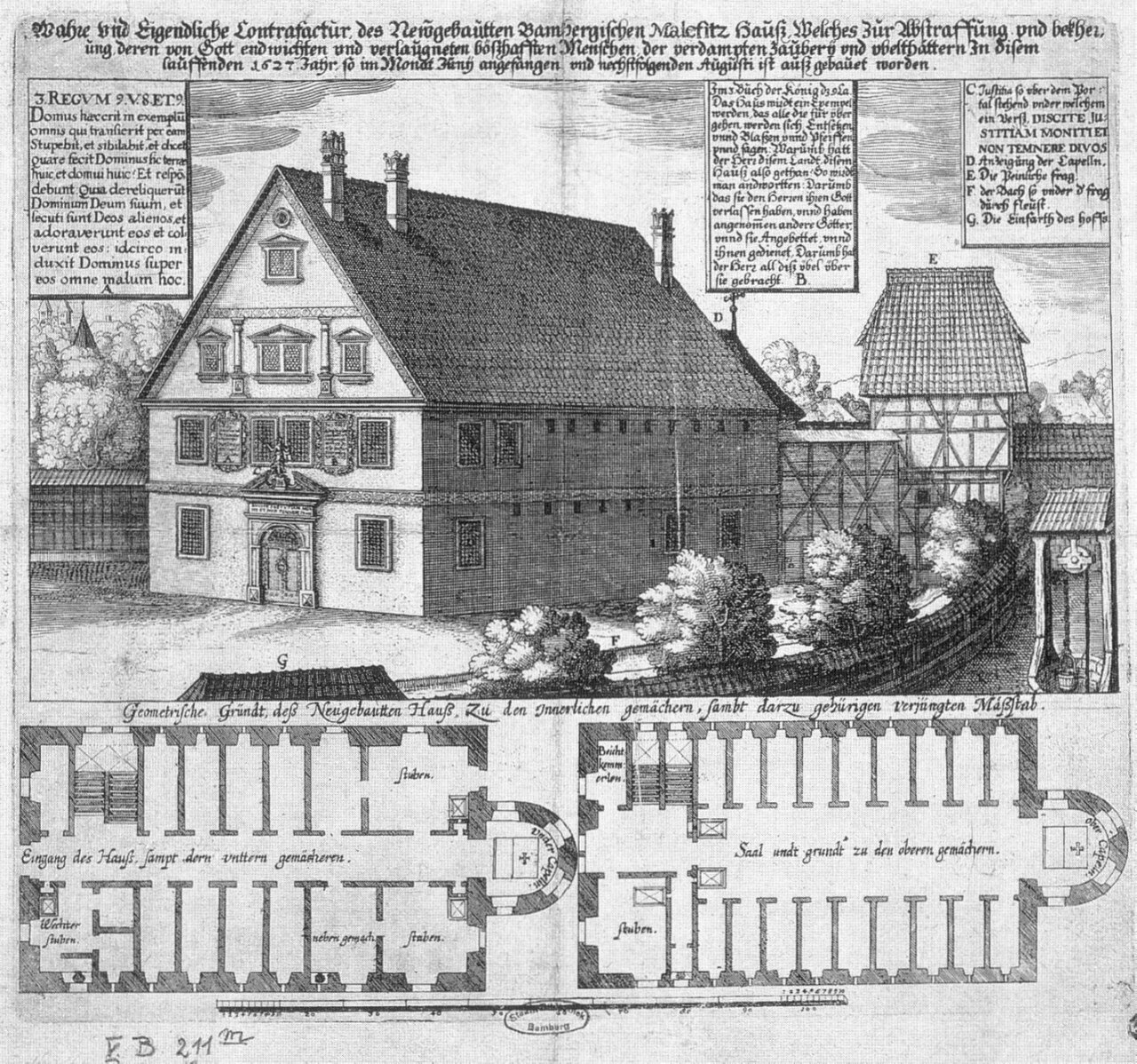
Johann Georg Fuchs von Dornheim became prince-bishop in 1623. Posterity has called him the Hexenbrenner, the witch-burner. His auxiliary bishop, Friedrich Förner, preached against the witches from the pulpit, and his sermons went into print. The work of prosecution fell to lawyers of the court council, acting as witch commissioners and paid separately for each trial. The confiscated property of the condemned only ever covered part of the cost. In 1627 the bishop and his auxiliary had a purpose-built prison erected for the accused, the Drudenhaus, where they were held and tortured. The wider German toll of those decades was set out in an earlier piece on these pages.
The Staatsbibliothek in Bamberg still holds the paperwork. It includes interrogation protocols, confessions, verdicts, wills, letters and slips recording pardons, as well as the bills for firewood and the menus. A persecution that keeps receipts for its firewood is not a frenzy. It is an administration.
The chancellor’s wife, Katharina Haan, was first questioned on 28 December 1627, without torture, and denied everything. In the sessions that followed she was put to the thumbscrews, the leg screws, and an hour and a quarter on the Bock, a torture seat, and she confessed. On 3 January 1628 she withdrew every statement made under torture. On 5 January her hair was shaved and a witch’s mark was found. She was burned on 24 January. Every member of her family died in the Bamberg trials. The burgomaster Johannes Junius, burned in the same years, left a letter to his daughter describing how his confession was obtained. It is one of the few documents of the persecution that English readers can find in translation.
⬥
How It Ended
The machinery did not stop in Bamberg because anyone repented. The relatives of the accused took their petitions to the emperor. The imperial Aulic Council (Reichshofrat) in Vienna began to intervene in the bishop’s proceedings. One historian of that intervention has argued that its late arrival was all that spared the city from complete economic ruin. In 1632 Swedish troops reached Bamberg, the persecution collapsed, and prisoners were set free. The prince-bishop fled. He died on 29 March 1633 at Spital am Pyhrn in Upper Austria.
In 1631 a book had appeared without its author’s name, arguing that torture could only ever confirm the accusation. A prisoner who confessed was guilty. A prisoner who stayed silent was being helped by the devil. The book, and the Jesuit who wrote it, were the subject of an earlier article on these pages. The argument has not aged. Every century since has found its own way of reading the refusal to confess as the surest evidence of the thing confessed.
⬥
The Second Card Index
Three centuries later the victims were counted again, by a different office for a different purpose. From 1935 to 1944, a special unit within the SS security service, the H-Sonderauftrag (Special Assignment H), sent fourteen full-time researchers through more than two hundred and sixty archives and libraries. They recorded the victims of the witch trials on some thirty-three thousand A4 sheets. The stated aims were material for evidence of a pagan Germanic folk religion that the trials tried to destroy. About a fifth of the cards concern the territory of present-day Bavaria. The unit also gathered a library of its own, and what became of it was the subject of an article here in 2017.
⬥
The Meadow
South of Bad St. Leonhard, near the old place of execution, the words UEBERAINS WERDEN have been mown into a sloping pasture. The memorial was opened in the autumn of 2025, and its makers read the old phrase as an invitation to come together. In 1493 the same two words were the court’s evidence of a pact. Grass grows back, and the letters have to be cut again.
Three women came to an agreement, and a court with a doctrine to test called it a contract. How much agreement among ordinary people does it take, in any century, before someone paid by the case calls it a pact?
