
The Outer Court — Third Degree
“Pray we now to God almight, / And to his moder Mary bryght.” — The Regius Poem, c. 1390
Around 1838 a young English antiquary, James Orchard Halliwell, was reading his way through a manuscript in the old royal collection. The catalogue described it as a moral poem. It opens with a Latin line: Hic incipiunt constituciones artis gemetriae secundum Euclydem, “Here begin the constitutions of the art of geometry according to Euclid.” Halliwell realised that it was not a moral poem at all. It was a rulebook for masons, the men who cut stone and raised churches. It had been written around 1390, and it is the oldest such document known.
Today the manuscript is kept in the British Library as Royal MS 17 A I, and is known as the Regius Poem.
⬥
The Builders
The Regius Poem is a practical document. It tells a master how to pay his men fairly, how long an apprentice must serve, and how a mason should behave towards his fellows. It treats geometry as the heart of the craft, because it was: in a trade that raised vaults over the heads of congregations, a mistake in the geometry could bring the roof down on them.
It is also, from beginning to end, a Christian document. The mason is told that holy church is God’s house and how to conduct himself at Mass. He is to pray to God almighty and to his mother Mary. The poem also tells the story of the Four Crowned Martyrs, the patron saints of the craft. They were stonecutters who refused to carve an idol for a pagan emperor, and were put to death for refusing.
The masons’ lodge, in those centuries, was a hut on the building site where the men kept their tools, ate and worked the stone. Their secrets were the secrets of a trade: how to set out an arch, how to raise a spire so that it would stand. They knew what they were building, and for whom.
⬥
The Gentlemen
In the seventeenth century, men who had never cut a stone began to be admitted to the lodges. On 16 October 1646 the antiquary Elias Ashmole noted in his diary that he had been “made a Free Mason” at Warrington in Lancashire. He was one of the first of these “accepted” masons on record, but not the last. Within a few generations the gentlemen outnumbered the builders.
Then the lodges acquired a head. According to the Reverend James Anderson, on 24 June 1717 four London lodges met at the Goose and Gridiron alehouse, near St Paul’s, and formed a Grand Lodge. That account appeared only in 1738, in the second edition of Anderson’s Book of Constitutions, twenty-one years after the events it describes. In 2017 two historians, Andrew Prescott and Susan Sommers, pointed out that it is the only source for that meeting. They argued that the first Grand Lodge event for which contemporary evidence survives took place on 24 June 1721. Even the institution’s founding date, then, rests on a single source written two decades after the event.
⬥
The Charge
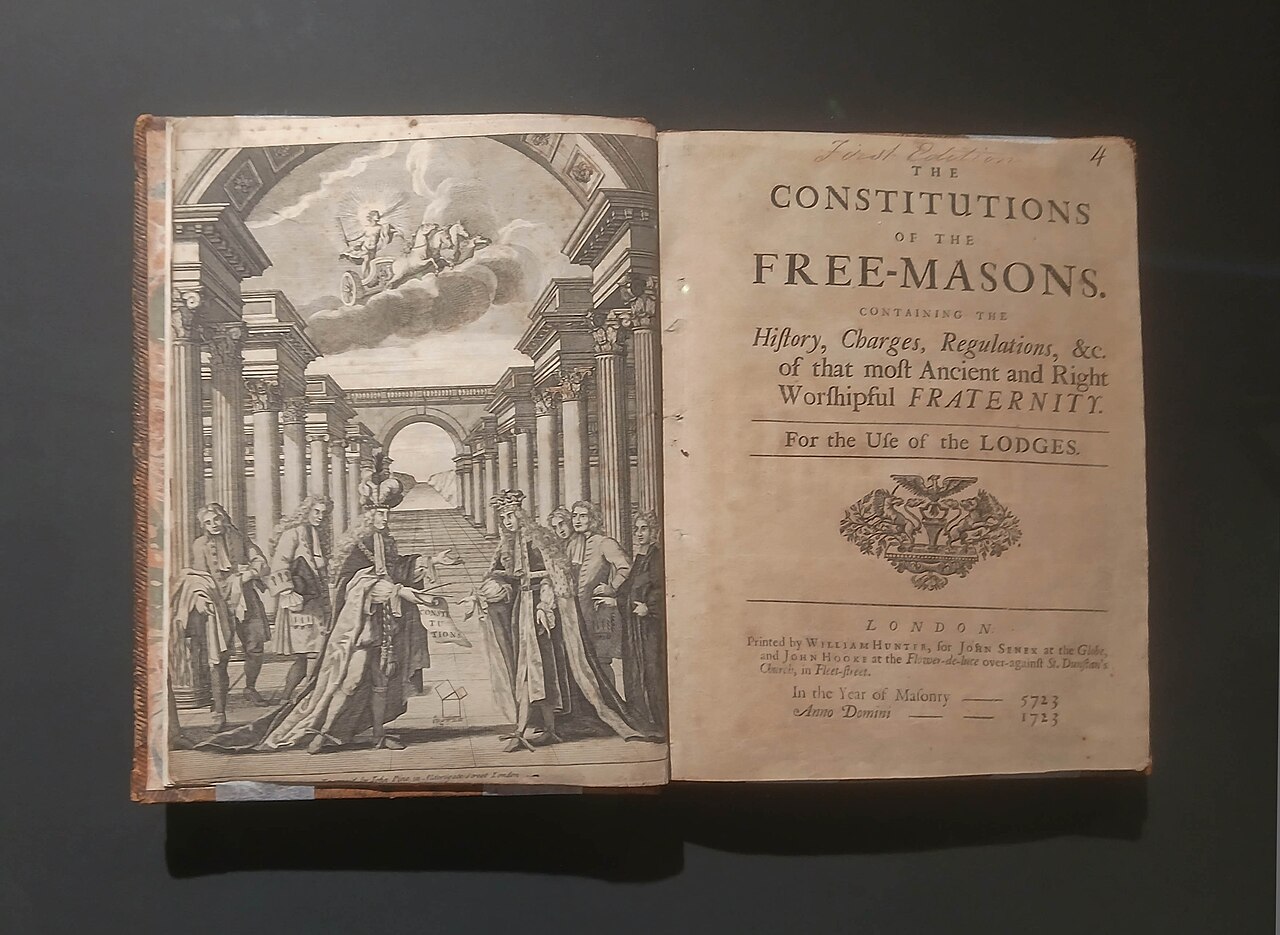
Anderson’s first edition had appeared in 1723. It set out the rules that every lodge under the new Grand Lodge was to observe, and it began with religion.
The old masons, the charge admits, had been obliged in every country to follow that country’s religion. It then continues: “’tis now thought more expedient only to oblige them to that Religion in which all Men agree, leaving their particular Opinions to themselves.” A mason was to be a good man and true, “by whatever Denominations or Persuasions” he might be distinguished.
Many read that sentence in its own time, and many read it today, as a charter of tolerance written after a century of religious war in Britain. It may well have been one. It was also something else. The apron, the trowel, the square and the temple were all kept. What was taken out was the faith the Regius masons had prayed in. In its place stood a religion with no name, one in which every man was assumed to agree.
Two hundred and thirty-four years later, a Swedish Secretary-General dedicated an empty altar in New York to “the God whom man worships under many names and in many forms.”
On that altar, see Everything Here Is a Gift.
⬥
The Porch
In 1871 Albert Pike, Sovereign Grand Commander of the Scottish Rite’s Southern Jurisdiction in the United States, published Morals and Dogma, a handbook of more than eight hundred pages. For decades it was given to members as they advanced through the degrees of his rite.
The first three degrees of Freemasonry, the ones every mason passes through, are known as the Blue Degrees. On page 819 Pike describes what the initiate finds there:
“The Blue Degrees are but the outer court or portico of the Temple. Part of the symbols are displayed there to the Initiate, but he is intentionally misled by false interpretations. It is not intended that he shall understand them; but it is intended that he shall imagine he understands them.”
In his preface Pike grants every reader the freedom to reject whatever in the book seems to him untrue or unsound. Many Masonic bodies today stress that the book was never official doctrine. The reader who stands in the porch, however, has Pike’s own word that he was not meant to know which parts those were.
⬥
What Remains
In 1390 the masons’ rule ended in prayer, and the saints of their craft were men who chose death rather than carve an idol. By 1723 the tools were still in their hands, but the prayer had been set aside for a religion in which all men agree. By 1871 the man who wrote the handbook of the higher degrees explained that those in the porch were meant only to think they understood.
The builders of 1390 knew what they were building, and for whom.
What is being built in the porch today, and for whom?
The Outer Court is a series in degrees. Previous: [Which Is to Be Master]. Next: The Idol.
