
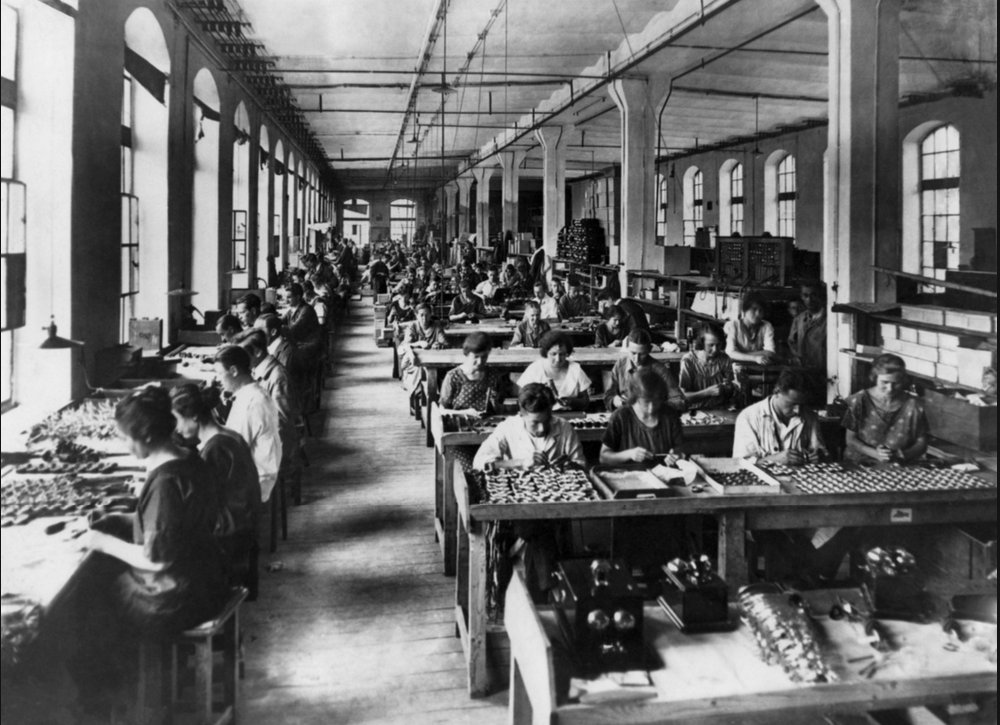
In December 1924, in Geneva, representatives of the world’s largest lightbulb manufacturers — General Electric, Osram, Philips, and others — signed an agreement capping the lifespan of a household lightbulb at 1,000 hours. Their own engineers had already built bulbs that lasted 2,500 hours or more. Member factories that exceeded the new limit were fined. The organization running the scheme called itself the Phoebus cartel, and its purpose was never hidden from its own members: a bulb that never burns out is a bulb that never gets bought again.
This is the acknowledged, documented origin of planned obsolescence as a deliberate industrial doctrine — not a folk legend, but a cartel agreement, minuted and fined. It is worth being precise about what kind of story this actually is, because the tempting version — a room of villains deciding to cheat the public — is also the least useful one. The more interesting question is what kind of economic environment makes a 2,500-hour bulb a losing product in the first place.
By 1924, the world’s major currencies were already eleven years into an era of centrally managed, expandable money supply — the same decade, as an earlier piece on these pages noted, that produced both the Federal Reserve and the founding myth of an art market detached from intrinsic value. A currency built to expand carries a quiet instruction to everyone transacting in it: standing still is falling behind. Savings held in such a currency do not stay level: measured in real purchasing power, roughly a hundred dollars of 1913 money buys only a few dollars’ worth of goods today. A business selling a single durable object, once, to a customer who will not need to buy another for decades, is trying to survive inside a system engineered to require continuous growth just to hold its position. The Phoebus engineers did not need to be cruel. They needed to notice, correctly, that the currency itself had already stopped rewarding what they were good at.
That is the pattern worth tracking across every case that follows — not a conspiracy of bad actors, but a monetary environment that quietly makes good, durable, honestly priced products into the least survivable business plan available.
An Old Arrangement, Briefly Defined
There is an older economic arrangement worth setting on the table before the modern examples begin — described the way a historian would describe it, not the way a campaigner would. In it, permanent title to land and tools belonged to one party. Everyone who actually worked that land held only a continuing right to use it — a right that lasted exactly as long as rent or service kept being paid, and that the title-holder could end. A man could improve that land for a lifetime. He could not leave the land itself to his children as something fully his to give. What he held, in the end, was never the thing. It was permission to keep using it, granted by someone else, for as long as someone else allowed.
Keep that shape in mind. What follows is not about that century. It is about receipts being signed today.
“A Bit Like Heroin”
In June 2024, the U.S. Federal Trade Commission and the Department of Justice sued Adobe, alleging the company had spent years steering customers into a subscription plan — paid monthly, but contractually locked for a full year — without clearly disclosing that cancelling early would trigger a termination fee worth half of everything remaining on the contract, sometimes hundreds of dollars. The complaint alleged the fee was buried in fine print and hidden behind hyperlinks, and that Adobe’s cancellation process was deliberately built to wear a customer down: dropped calls, disconnected chats, repeated transfers.
What made the complaint land harder than the usual regulatory boilerplate was a line from Adobe’s own internal correspondence, produced in discovery. An unnamed company executive, describing the termination fee’s value to the business, called it, in his own words, “a bit like heroin for Adobe.”
That is not a critic’s metaphor. That is the company’s own account of its own mechanism.
The License, Not the Machine
In 2024, Ubisoft shut down its 2014 racing game The Crew, deleting it from the libraries of everyone who had purchased it a decade earlier. When players sued, Ubisoft’s lawyers argued in court filings that customers had never actually owned the game — only, in the company’s own phrase, “a limited license to access” it. The plaintiffs’ filing offered its own comparison: buying a pinball machine, only to have the manufacturer return years later and remove the paddles, the bumpers, and the scoreboard.
This is the quiet redefinition sitting underneath most software sold today. The purchase screen still says “buy.” The receipt still uses the language of a transaction that transfers ownership. What actually transfers is permission — granted by one party, to be revoked by that same party, on terms that party alone can rewrite.
Even the Government Agreed
Software licensing is one thing when the product is a video game. It becomes a different order of problem when the product is the machine a farmer’s entire harvest depends on.
In January 2025, the FTC and five state attorneys general sued Deere & Company, alleging the manufacturer had spent decades restricting the software diagnostic tools needed to repair its own tractors to a closed network of authorized dealers — forcing farmers who owned the equipment outright to pay Deere, and only Deere, for repairs Deere’s own machines were capable of running. The complaint described this as unlawfully maintained monopoly power, not a customer-service preference. Deere settled in July 2026, agreeing under ten years of FTC supervision to give equipment owners and independent repair shops the same diagnostic access its own dealers already had — a settlement that followed a separate $99 million payout Deere had already made months earlier to farmers who sued directly over the same restrictions.
A tractor is, in every physical sense, a machine a farmer owns outright. What the lawsuit made visible is that ownership of the steel had stopped being the part that mattered. The software gatekeeping the steel’s own diagnostic ports was never sold. It was only ever licensed, and the license only ever pointed one way.
The Same Appetite, a Different Currency
A previous piece on these pages traced how art detached from durable, verifiable value once an institutional consortium gained the standing to simply proclaim what counted as valuable. Ownership is undergoing the same detachment, through the same mechanism, dressed as a software update. A currency that can be devalued by decree rewards whoever controls the decree and punishes whoever is merely holding the currency when it happens. A product that can be revoked, throttled, or discontinued by decree works exactly the same way — except what’s being devalued isn’t a number in an account. It’s the object you were standing next to when you thought you owned it.
Why the Good Product Goes Broke
Here is the part that isn’t conspiracy, just arithmetic. A well-made object, sold once, durable, repairable, is a single transaction. A product that can be revoked, license-gated, or designed to fail on a schedule is a recurring one. Between those two business models, the incentive does not sit neutrally. It actively rewards the second and punishes the first — a company that builds something too good, too durable, too easily repaired by its own owner, has built itself a worse balance sheet than a competitor who didn’t.
The 1924 engineers who could already build a 2,500-hour bulb were not told to stop being good at their jobs. They were told the market had no room left for what they were good at.
There is a second arithmetic sitting underneath the first one, and it explains why the smallest, most honest producers are usually the first ones pushed out. A one-person or five-person workshop making a genuinely good product still has to carry the same fixed costs as a much larger competitor — the same accounting, the same compliance filings, the same recurring taxes and social-security overhead — but has far fewer sales across which to spread them. In practice, a business needs to reach a certain scale, commonly cited in European small-business literature as somewhere around two dozen employees, before those fixed costs stop eating a disproportionate share of every sale. Below that line, a small producer is not just competing against a larger one on price and marketing. It is competing while carrying a heavier weight per unit sold, in a currency that is simultaneously losing value under both of them every year they hold still.
Not the Word’s Fault
None of this is what the word “capitalism” was supposed to mean, and it is worth saying plainly rather than leaving the word to do work it was never built to carry. Even Adam Smith — the writer most often credited as capitalism’s founding voice — warned against exactly this dynamic in 1776: that people in the same trade, left to their own devices, rarely gather without the conversation drifting toward some scheme to raise prices at the public’s expense. A system built on genuine production, honest exchange, and competition on merit is not the same system as one where survival requires locking customers into recurring payments for something they were told they’d bought outright. The first produces things. The second extracts from people who already have things. Calling the second one “capitalism” and the first one by the same name has done real damage to the word — and communism, built on state monopoly over production instead of private monopoly over access, arrives at the same extraction by a different door. Neither label is really doing the describing anymore. What is actually happening, in both cases, is a system feeding on the people producing and buying inside it, regardless of which flag is flying over the transaction.
⬥ ⬥ ⬥
A civilization that no longer sells its citizens finished things — only access, revocable on schedule — has changed what the word “yours” means, without ever holding a vote on it. Nobody had to lie to make that happen. They only had to change what the receipt actually promises, and wait for everyone to stop reading it.
