
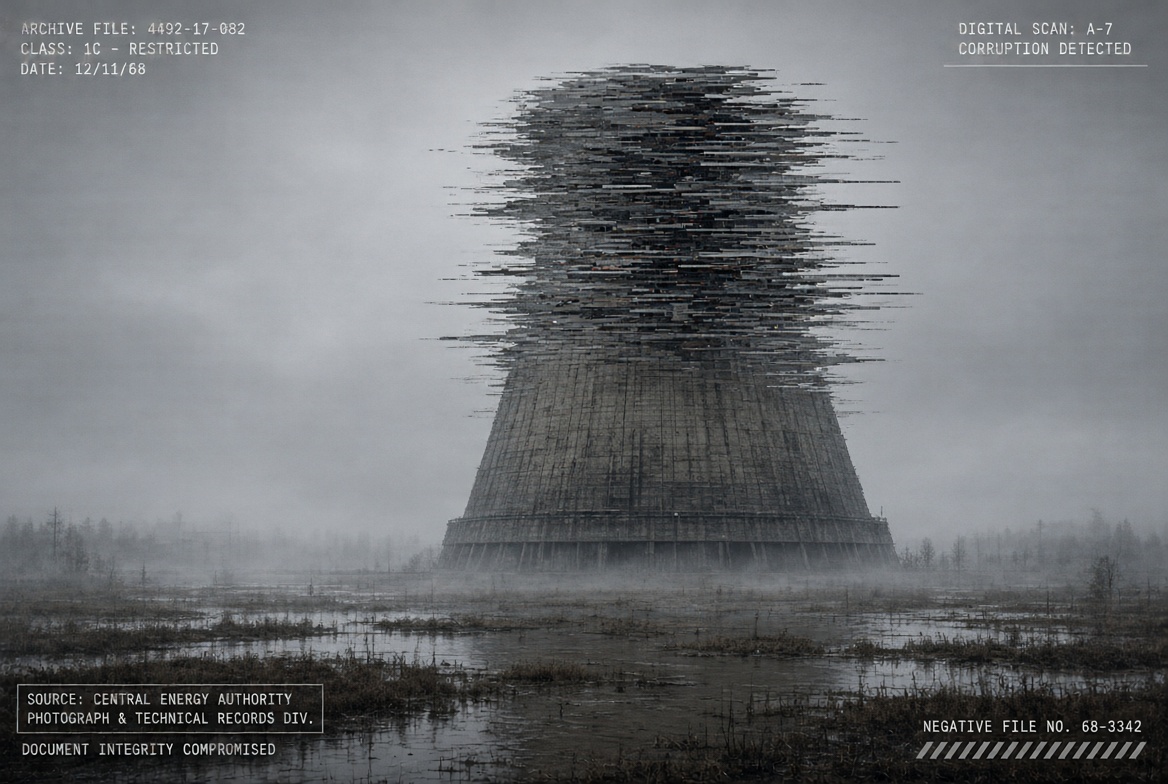
There is a recurring delusion within the architecture of the modern administrative state: the belief that the digital apparatus—the sprawling, insatiable machinery of data and computation—possesses a reality independent of the physical world. For years, the architects of this system have acted as if the “Cloud” were a bottomless well, a frictionless domain where value could be printed, and intelligence could be scaled, at the mere cost of more silicon and more code.
But a system that ignores the friction of the world will eventually be brought to a halt by the world itself. We have reached the point of structural saturation. The expansion of the Machine has encountered a physical wall, and the protocols of the Automated State are now entering their terminal phase: the Gridlock Protocol.
The Threshold of Friction
The Machine’s expansion relies on a simple, unchecked equation: unlimited capital plus unlimited energy equals unlimited growth. This equation functions perfectly in the realm of the synthetic, where numbers and tokens require no oxygen, water, or ground.
However, when the Machine attempts to materialize its appetite—when it demands thousands of acres for data enclaves, millions of gallons for cooling, and a constant, unwavering stream of high-voltage power—it inevitably collides with the host civilization.
When the local community, the municipal regulator, or the geographical terrain itself says “no,” it is not an obstacle to be “managed.” It is the physical world reasserting its primacy over the digital simulation. The Machine, long accustomed to treating physical space as a neutral background for its operations, is discovering that the “common” infrastructure of a civilization is not an infinite resource. It is a finite, shared foundation that the Machine has been strip-mining to fuel its own isolation.
Systemic Glossary // Saturation
// THE GRIDLOCK PROTOCOL
The emergent systemic response when an industrial-intelligence apparatus exhausts the physical and civic resources of its host society. As the Machine’s internal capital needs exceed the host’s ability to provide land, energy, and labor, the system defaults to “Gridlock”—a state of constant maintenance, escalating costs, and localized resistance that prevents further expansion, forcing the Machine to choose between collapse or radical enclosure.
The Financial Reflex
The volatility currently observed in the markets is the financial apparatus reacting to this physical collision. The debt currently propping up this machine—leveraged against expectations of perpetual AI growth—is inherently fragile. It is backed not by goods, services, or durable infrastructure, but by the assumption that the Machine will never face a constraint it cannot “optimize” away.
When the expansion halts, the collateral begins to vaporize. The credit curves, the synthetic debt, and the “AI-collateralized” instruments are now witnessing a rapid reality check. The market is not “crashing” in the traditional sense; it is merely decoupling from a growth promise that the physical world has effectively refused to honor.
The Theater of the Emergency
In these moments of stalled momentum, the Automated State instinctively reverts to the Theater of the Emergency. When the internal ledger of the Machine can no longer justify its own growth, the political class is prompted to escalate the external tension.
The theater of war, the rhetoric of existential threat, and the staging of political “crises” are not the causes of current instability. They are the buffers. They serve to keep the attention of the populace fixed on a distant, dramatic horizon, ensuring that no one asks why the growth has stopped, why the energy is being rationed, or why the infrastructure of the common life is being systematically dismantled.
The Final Audit
The Machine is not “progressing.” It has simply reached the boundaries of its simulation.
The Gridlock Protocol is the mechanism that reveals the Machine’s true nature: it is a parasite that requires a surplus to thrive. Deprived of that surplus by the physical limitations of the host—the scarcity of water, the exhaustion of the grid, the refusal of the citizen to be further optimized—the Machine does not reform. It pivots. It secures its own remaining power, isolates its core assets behind private lines, and leaves the host to manage the decay.
If you are wondering why the promises of the last decade have begun to ring hollow, understand that you are not witnessing the failure of the Machine. You are witnessing the moment the Machine decided it no longer needed you to facilitate its growth.
The simulation has hit the wall. The question for the reader is not whether it will recover, but how to orient oneself when the lights finally dim on the simulation, and the reality of the ground beneath our feet is all that remains.
