
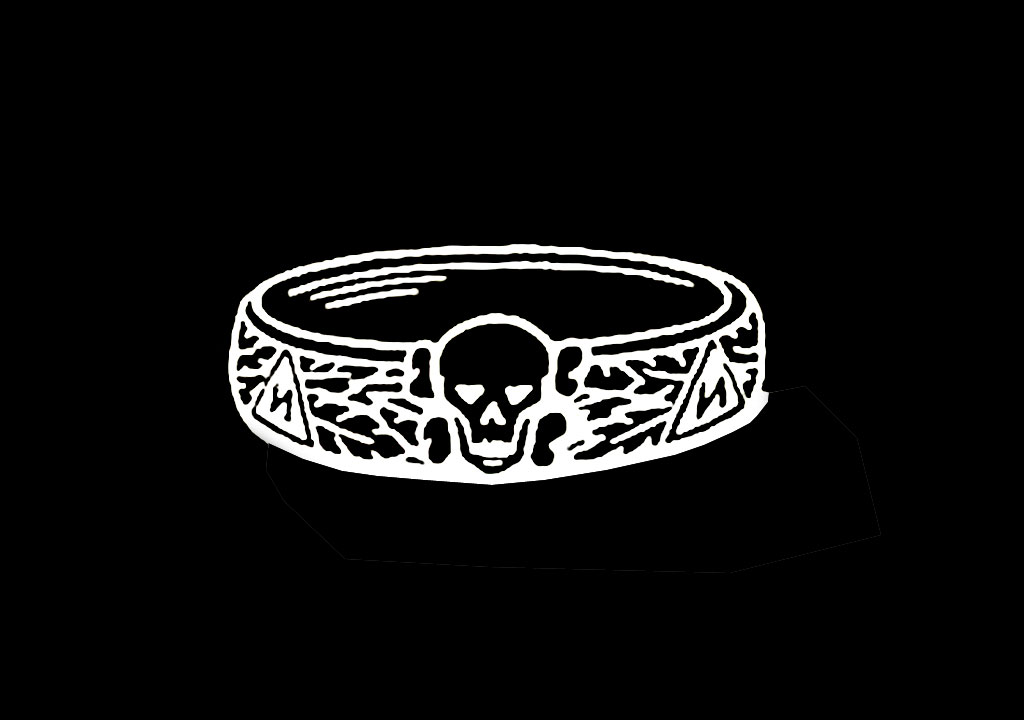
On 1 January 1945, with the war already lost in the east and the west, an office of the SS still found time to count rings. Of the roughly fourteen thousand five hundred that had been made, its figures said, sixty-four in every hundred had come back to the castle of Wewelsburg in Westphalia on the death of the men who wore them. Ten in every hundred had been lost on the battlefield. The remaining twenty-six were still on living fingers, or no one knew where they were.
Three months later, the rings that had come back were gone. Where they went is the one question about Wewelsburg that no archive has answered.
⬥
The Ring
It was not a medal. The state did not award it, and it could not be bought. It was a personal gift from Heinrich Himmler, a heavy silver band with a death’s head and a ring of runes, and inside it the name of the man who received it, the date, and a facsimile of Himmler’s signature. The idea was Himmler’s. The design is credited to Karl Maria Wiligut, of whom more below, and every ring was made to measure by one firm of jewellers in Munich, Gahr. It came with a letter, which forbade the ring to be sold, copied or passed on. It was to be worn on the left hand. Himmler also forbade photographs of it to be published; when the SS wanted to show it, it had it drawn.
When the man died, his family could keep the letter. The ring had to be sent back. From 1938 the returned rings were kept at Wewelsburg, in what the SS called a shrine to the holders of the ring, as a sign that the dead man still belonged to the order. According to the castle’s historian, Karl Hüser, the rings of men who fell in battle were kept in a place of their own in the vault beneath the North Tower, the round room the SS called Walhalla, the hall of the slain. Rings of men who had left the order in other ways were, as a rule, melted down.
⬥
The Birch Tree
Why Wewelsburg? The castle is a triangle of stone on a spur above the Alme valley, built between 1603 and 1609 for the prince-bishops of Paderborn. Himmler first saw it on 3 November 1933. Whether Karl Maria Wiligut was with him that day, the accounts disagree. Wiligut was the Austrian who called himself the heir of an ancient Germanic line and who became, for a few years, Himmler’s personal adviser on runes and the distant past. What the accounts agree on is that he did more than anyone to shape what the castle was meant to be: the centre of an order, and the centre of a world.
Westphalia had an old story of its own. Its first printed form appeared in Cologne in 1701, in Latin, in a small book by an author who did not give his name and who said he had been enlightened by visions; it was printed with the permission of the church court at Werl. It foretold a terrible war of the South against the North, ending in a battle of three days “at the borders of the Duchy of Westphalia”, which would begin at a little birch wood near the village of Budberg. Men would wade in blood to the ankles. In the end, the text says, the bearded peoples of the Seven Stars would win.
The people of the Hellweg kept the story and kept adding to it. In 1830 a shepherd from a village near Dortmund said the battlefield reached from Unna to Hamm and Werl, and spoke of a great flight of peoples moving from east to west. On the evening of 22 January 1834 a crowd saw a battle in the sky over the plain, cavalry and all, wheeling towards the village of Hemmerde. In 1849 a collection of prophecies printed the text again. The poet Ferdinand Freiligrath, who grew up in the region, gave the place a poem of its own, Am Birkenbaum, begun in 1829 and finished in 1850. As late as 1920, a local historian recorded, there were people near Kamen who believed they could already see the blood of the battle running down their stream, and a householder who wanted to sell his farm before it flooded red. In 1927 a schoolteacher in Werl, Franz Lotze, gathered the tradition into his book of the legends of the Haar and the Börde.
Somewhere along the way, the enemy changed direction. The text of 1701 speaks of the South against the North. The version that reached the twentieth century spoke of a vast army coming from the East.
It has been said ever since that Wiligut had this prophecy in mind. Himmler and Wiligut did think of the castle as a bulwark against the East, and the East they meant was Bolshevik Russia. Whether a birch tree on the Hellweg had anything to do with it, no order, no letter and no minute shows.
One detail is seldom mentioned. The birch wood near Budberg and the plain around Werl lie more than fifty kilometres west of Wewelsburg. If the legend did guide the choice, it had first to travel to find its castle, and it had already turned once to face a new enemy.
⬥
October 1944
In October 1944, Himmler stopped the making and awarding of the ring for the rest of the war. The silver and the craftsmen were needed elsewhere, and the men who might have received it were dying faster than rings could be engraved.
The count of 1 January 1945 followed. Sixty-four in every hundred of some fourteen thousand five hundred is a little over nine thousand rings. That is the number that would matter in the spring.
⬥
Three Endings
On 30 March 1945, with the American 3rd Armored Division approaching, the commandant of the castle left. The next day, 31 March, a small SS detachment under Heinz Macher, one of Himmler’s personal staff, arrived with orders to blow up Wewelsburg so that nothing in it would fall into enemy hands. The charges brought down part of the castle, and the fire did the rest; Macher, it is recorded, told the local fire brigade not to put it out. The North Tower, with its domed crypt and its hall above, survived. On 2 April 1945 American troops took the burned-out castle and freed the prisoners still held at the camp below it.
What happened to the rings is told three ways.
The first is the version kept by the Imperial War Museum in London. In the spring of 1945, its catalogue states, the rings from the shrine were blast-sealed into a hillside near Wewelsburg on Himmler’s orders, so that the Allies would not have them. Which hill, and on whose testimony, the catalogue does not say.
The second is told in the war histories that follow Macher. His detachment took the rings, some nine thousand of them, away from the castle and buried them at a secret place in the woods nearby. The number matches the count of January.
The third is the version of the castle’s own historian. In 1982 Karl Hüser wrote that a store of rings in the vault had come through the explosion, the fire and the villagers who went through the ruins in the days before the Americans arrived, and that in the end it was American soldiers who took them. The village tells the same story. But Hüser speaks of hundreds of rings, not thousands.
If hundreds lay in the vault, the arithmetic of January asks where the other eight thousand went. No hoard has ever surfaced, in a hill, in the woods, or on the market. No one has ever announced that they opened the hill.
⬥
A Question for the Hill
The prophecy names no year. It has not yet come true, and it has not been forgotten. The rings were counted to the last decimal, and then they disappeared. Somewhere there are some nine thousand names engraved in silver: in a sealed hill near a triangular castle in Westphalia, or under a patch of woodland, or scattered through the attics of another continent, or nowhere at all.
If the hill were ever opened, which would be stranger: to find the rings, or to find nothing?
The next article on Wewelsburg will follow the castle’s own record, from the witch trials of 1631 to the plan that was still being drawn after the building had stopped.
