
By: The Archivist
Filed under: The Observer | 10 September 2026
In the study of administrative machines, a “Policy Error” is a specific diagnostic indicator. It is the moment when those responsible for the control loop admit that their primary tools—interest rates and monetary supply—no longer produce predictable results.
Throughout the first week of September 2026, major institutional nodes, including Goldman Sachs and Morgan Stanley, began publicly framing current market conditions as a fundamental “Policy Error.” To the observer, this is not merely a critique of a central bank’s decision; it is a signal that the administrative state’s credit-management apparatus may have reached the limits of its operational authority.
I. The Loss of the Control Loop
When the cost of servicing sovereign debt conflicts with the necessity of fueling a debt-dependent technology expansion, the system faces an unavoidable trade-off. For months, the “AI build-out” served as the primary credit-sink for the system, absorbing liquidity and maintaining the velocity of capital.
The data indicates that this mechanism is now encountering systemic friction. When financial analysts describe the situation as a “Policy Error,” they are noting that the ledger is no longer responding to the levers of control. The debt stack—now bolstered by $3.1 trillion in off-balance-sheet liabilities—appears to be operating on a trajectory that sovereign interest-rate policy can no longer steer.
[SYSTEMIC GLOSSARY: THE POLICY ERROR]
What is a “Policy Error”? In the context of central banking, a policy error occurs when the regulator’s actions—raising or lowering rates—fail to stabilize the intended economic metric. It is the admission that the steering wheel of the economy is no longer connected to the road.
Why is this significant? When major institutions label a situation a “policy error,” it signals that the administrative state has exhausted its conventional tools. The system is no longer “fine-tuning” the economy; it is reacting to systemic pressures it no longer understands or controls.
The Systemic Friction: The current market “sullen vibe” reflects a deeper reality: the gap between the official narrative of a managed economy and the reality of a credit-strained infrastructure. When the central bank becomes a “passenger” to corporate debt requirements, the state must choose between the stability of its currency and the survival of its primary industrial monopolies.
II. State Infrastructure as the New Credit Backstop
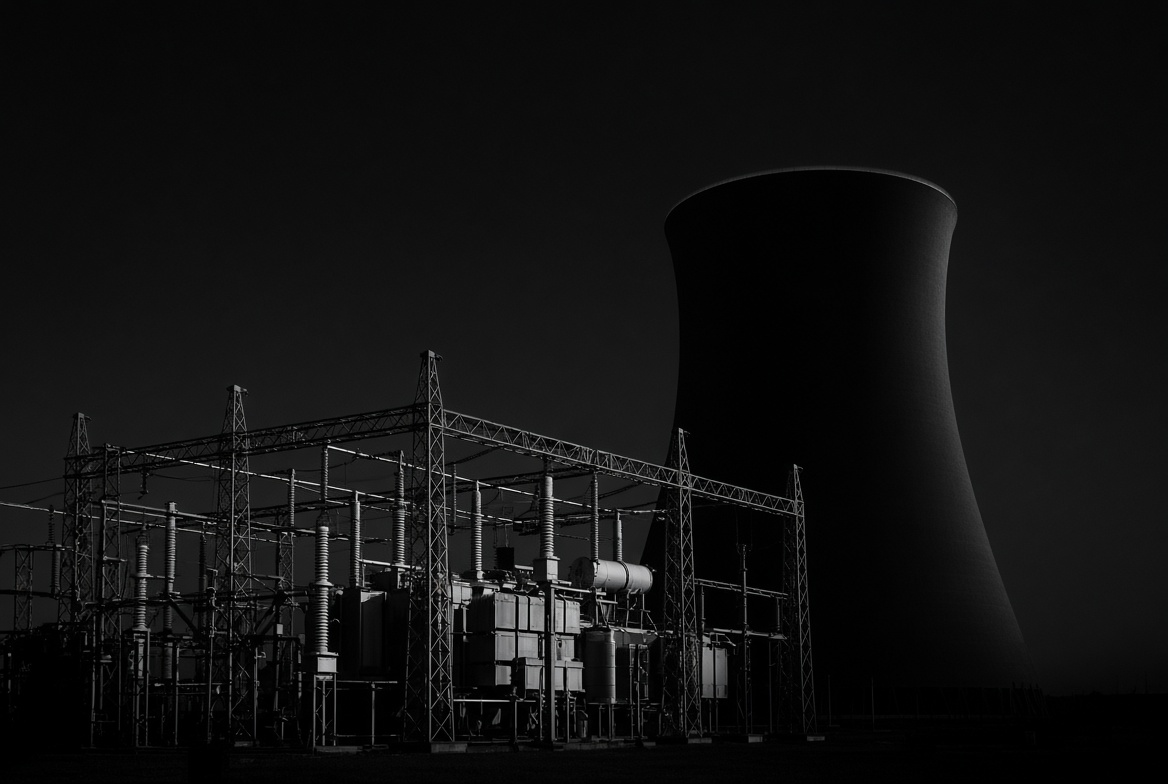
While the financial sector debates the “policy error,” the physical infrastructure sector provides a different, more concrete signal. This week, the US Department of Energy finalized multi-billion dollar loans to restart dormant nuclear power facilities specifically to satisfy the energy demands of private data-center conglomerates.
This represents a qualitative change in the role of the state. It is no longer acting as a regulator overseeing a market; it is functioning as the physical infrastructure provider
for a digital enclosure. When the state prints energy (via nuclear restart funding) to enable the printing of data (AI), it validates that the digital build-out is now a critical national asset.
III. The Contradiction of the Digital Enclosure
The state is attempting a difficult transition: it is offloading digital debt liabilities onto private balance sheets while simultaneously securing the physical inputs (energy, uranium, rare earths) that the state deems essential for national security.
The signals observed this week—the admission of a “policy error” in interest rate management and the state-led centralization of power generation for data centers—suggest that the administrative state is attempting to secure the physical inputs of the economy while the financial inputs (the credit stack) become increasingly detached from reality.
Synthesis
Is the state effectively “de-grossing” from the open market and transitioning into a command-infrastructure model for the digital sector?
The observable data indicates a shift toward a system where corporate credit and state energy planning are effectively the same loop. Whether this consolidation will successfully manage the looming $3.1 trillion credit stack or merely centralize the impact of its eventual restructuring remains an open question.
Archivist’s Evidence Log: #TMF-2026-09-10-OBSERVER-POLICYERROR
Policy Error Consensus: Institutional market analysis now formally prices in a loss of Federal Reserve steering efficacy, confirming a detachment from conventional interest rate models.
Energy Integration: DOE direct financing for nuclear reactor restarts signals the state’s transition into a provider of critical industrial inputs for private AI credit sinks.
Structural Pivot: The administrative state is underwriting the energy costs of its own digital ledger, prioritizing the continuity of its infrastructure over independent market regulation.
Observational Note: Policy error admission coincides with energy-state centralization, suggesting the “reset wall” is no longer an abstract fear but a managed fiscal event.
