
By: The Archivist | 2 October 2026
There is an old fiction, carefully maintained by the administrators of the modern state, that the public infrastructure is a common vessel—a shared room whose lights, water, and pathways are maintained for the mutual benefit of those who dwell within its walls. When energy grows scarce, the citizen is instructed to dim the lamp; when the ledger frays, the public is reminded that belt-tightening is a collective civic virtue.
Yet, if one observes the architecture of the current decade rather than the rhetoric of its managers, a very different reality emerges. The machine is quietly cutting the cord.
The Enclosure of the Grid
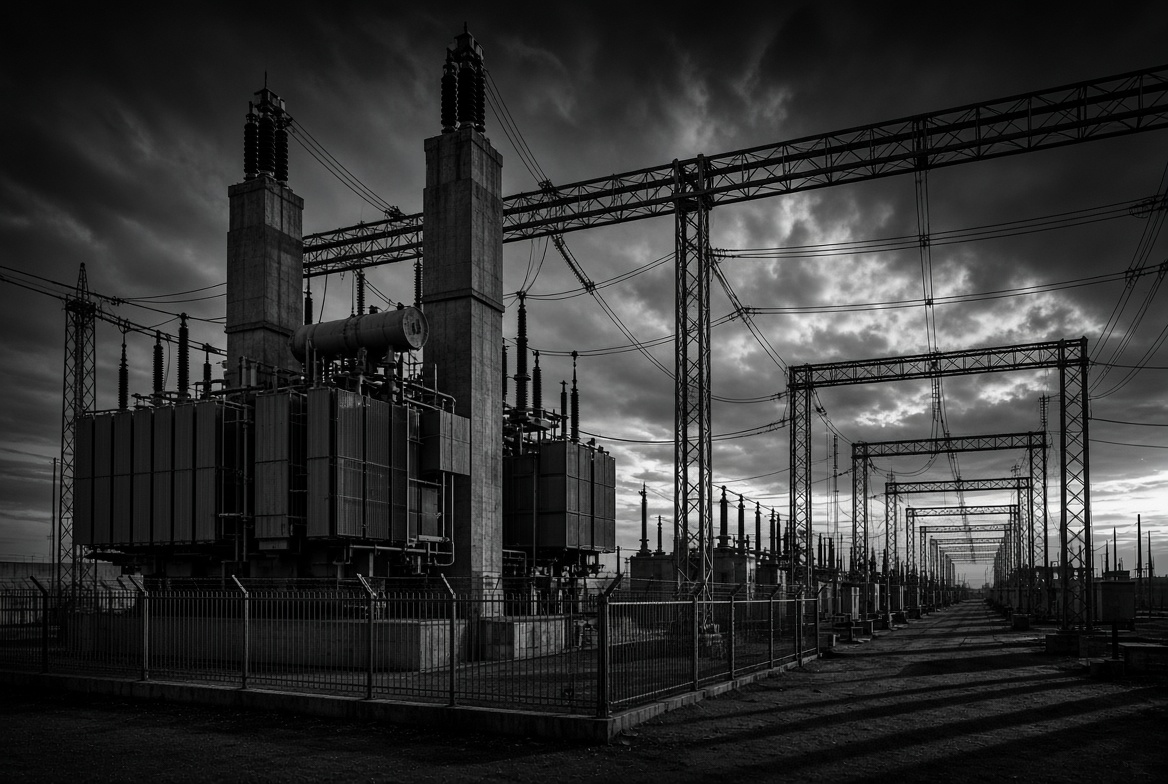
Over the past fortnight, the financial ledgers have begun to register a peculiar divergence. While municipal utility boards and ministerial offices urge households toward conservation, corporate conglomerates executing the massive build-out of artificial intelligence infrastructure are quietly cutting out the middleman. They are building their own power plants.
In the language of the energy markets, it is known as “behind-the-meter” generation—a technical term for an industrial apparatus that draws its megawatts directly from the source, bypassing the public grid entirely.
This is not merely a logistical necessity for high-density compute; it is a profound structural pivot. The public electric cooperative is left to manage the decaying transmission lines, the rolling brownouts, and the rising tariffs of a starved populace, while the essential nodes of the new economy carve out private, high-voltage enclaves. It is an administrative triage. The state no longer pretends that the grid can sustain both the citizen and the machine. And so, with quiet efficiency, it has authorized the privatization of the current itself, ensuring that the “Frontier” infrastructure remains electrified while the hinterland remains in sunset.
Systemic Glossary // Triage
// BEHIND-THE-METER
A method of bypassing public utility grids by installing dedicated generation (gas turbines, small-modular nuclear) directly at the site of consumption. While framed as an efficiency measure, it functions as a mechanism for institutional survival, decoupling high-value industrial assets from the inevitable failure of public infrastructure.
The Math of the Infinite
This physical enclosure of energy is mirrored by a remarkable suspension of financial gravity. Public disclosures from the primary architects of the intelligence apparatus reveal balance sheets operating on a scale that defies traditional economic calculus—hundreds of billions in unbacked spending commitments balanced against vanishingly thin margins of immediate return.
To the orthodox economist, this appears as an unsustainable bubble, a fever dream of easy money colliding with high interest rates. But viewed through the forensic gaze, it suggests something else: a calculated gamble that if the capital expenditure is large enough, and the energy consumption absolute enough, the resulting apparatus will achieve a level of systemic lock-in that renders conventional solvency irrelevant. When you own the intelligence that governs the market, the debt used to build it becomes merely a footnote in a newly rewritten ledger.
The Ledger Remains
The pattern is consistent across every sector of the Automated State. The housing stock is compressed into shared, managed enclosures; the transit network is tethered to digital synchronization points; and now, the very lightning that powers the civilization is being gathered behind private walls, reserved for the few who write the code.
The transition is polite, incremental, and wrapped in the reassuring vocabulary of technical progress. But the direction of travel is unmistakable. The machine is preparing for a future where it no longer needs the legacy grid it outgrew—or the populace it once deemed necessary to maintain it.
The machine is not “progressing.” It is merely exiting.
