
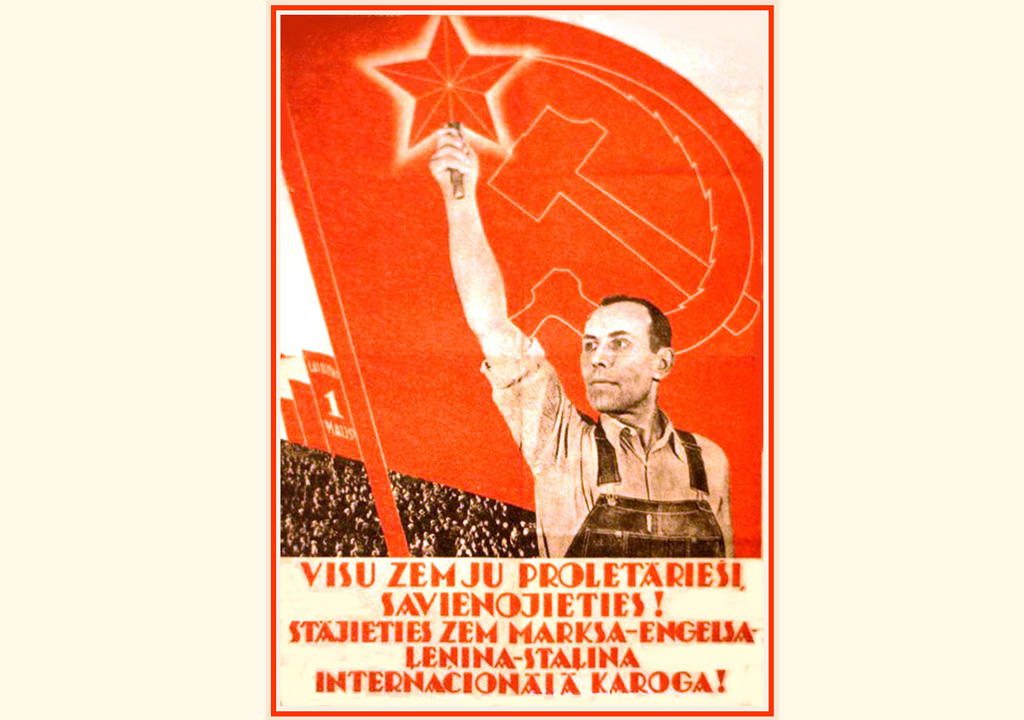
The Outer Court — Fifth Degree
“Let their rule hold not through me!” — Aleksandr Solzhenitsyn, Live Not by Lies, 12 February 1974
In October 1978, in Prague, the playwright Václav Havel finished a long essay and dedicated it to the memory of the philosopher Jan Patočka, who had died the year before after a series of police interrogations. The essay could not be printed in Czechoslovakia. It circulated in typed copies, passed from hand to hand. Its title was The Power of the Powerless.
At its centre stands a man nobody would look at twice.
⬥
The Greengrocer
The manager of a fruit-and-vegetable shop, Havel writes, places in his window, among the onions and carrots, the slogan “Workers of the world, unite!”
He does not do it out of enthusiasm. He has probably never given a moment’s thought to what the words mean. The sign came from headquarters along with the vegetables. He puts it up because it has been done that way for years, because everyone does it, and because that is the way it has to be. If he refused, there could be trouble.
So what does the sign actually say? Havel translates it. Its real message is not about the workers of the world. It says: I, the greengrocer XY, live here and I know what I must do. I behave in the manner expected of me. I can be depended upon and am beyond reproach.
Then Havel makes a small experiment. Suppose, he says, that the greengrocer had been instructed to display the slogan “I am afraid and therefore unquestioningly obedient.” He would not be nearly so indifferent to its meaning. He would be ashamed to put it up. The official slogan spares him that shame. It lets him hide his obedience behind something that sounds high-minded. The ideology, Havel writes, is an alibi.
Nobody has ordered this particular greengrocer to believe anything. Nobody checks whether he does. The slogan hangs in his window, and in the next window, and in the office where the woman who walks past his shop works. She does not read his sign, just as he does not read hers. Each of them is a small part of what everyone sees, and so each of them helps to hold up the whole.
⬥
Nobody
Eight years earlier, in 1970, the political philosopher Hannah Arendt had described the same machinery from the outside. In her essay On Violence she called bureaucracy the rule of Nobody. Rule by Nobody, she wrote, is not the absence of rule. Where everyone is equally powerless, there is a tyranny without a tyrant. She considered it perhaps the most tyrannical form of all, because there is no one left who could even be asked to answer for what is being done.
Havel’s greengrocer lives inside Arendt’s sentence. He did not write the slogan. The man at headquarters who sent it did not write it either. Whoever did write it is long retired or dead. Everyone passes the sign along, and nobody owns it.
On what an idol is made of, see They That Make Them.
⬥
The Day He Stops
Then Havel imagines the greengrocer changing his mind.
One day something in him snaps, and he stops putting up the slogan. He stops voting in elections he knows to be a farce. He begins to say what he really thinks at political meetings. He even finds the strength to stand by those whom his conscience tells him to support.
Havel lists the consequences in the plain tone of a man who knew them from experience. The greengrocer will be relieved of his post as manager and transferred to the warehouse. His pay will be reduced. His hopes of a holiday in Bulgaria will evaporate. His children’s access to higher education will be threatened. His superiors will harass him and his colleagues will wonder about him. Most of those who apply the sanctions will not do so out of conviction. They will do it under the same pressure that once made him put up the sign.
Why such an effort over a piece of cardboard? Because, Havel writes, the greengrocer has done something far more dangerous than insult the government. He has said that the emperor is naked. And because the emperor is in fact naked, something extremely dangerous has happened. One window without a sign shows every passer-by that a window can be left empty.
⬥
Not Through Me
Four years before Havel’s essay, another writer had made the same demand, and made it smaller still.
On 12 February 1974, Aleksandr Solzhenitsyn released a short text called Live Not by Lies. He was arrested the same day, and the next day he was put on a plane and expelled from the Soviet Union. The text asked for no uprising, no organisation and no heroism. It asked only that each person refuse to take part in the lie personally: not to write it, not to repeat it, not to applaud it, and not to hang it in the window. The lie might go on ruling, he wrote. Let their rule hold not through me.
In May 1979 Havel was arrested and later sentenced to four and a half years in prison. In December 1989, eleven years after he had written about the greengrocer, he was elected president of Czechoslovakia.
⬥
What Remains
This series began with an altar in New York, emptied of every symbol and dedicated to a God with many names. It went on to a book in which rulers are granted the privilege of lying, and to a porch where the initiate is meant to think he understands. It came to an idol made of nothing but the earrings of the people who bowed to it. None of these needed a master who commanded everything. Each needed only people willing to bring something to it, and to keep bringing it.
Havel’s greengrocer did not bring gold. He brought a sign, and the sign was enough.
Whose sign is in your window, and did you put it there?
The fifth degree closes the first cycle of The Outer Court. Previous: [They That Make Them].
The Outer Court is written and published independently. If it gave you something, the Well of Offering keeps the door open.
