
The Outer Court — Second Degree
“If any one at all is to have the privilege of lying, the rulers of the State should be the persons.” — Plato, Republic, Book III (trans. Benjamin Jowett)
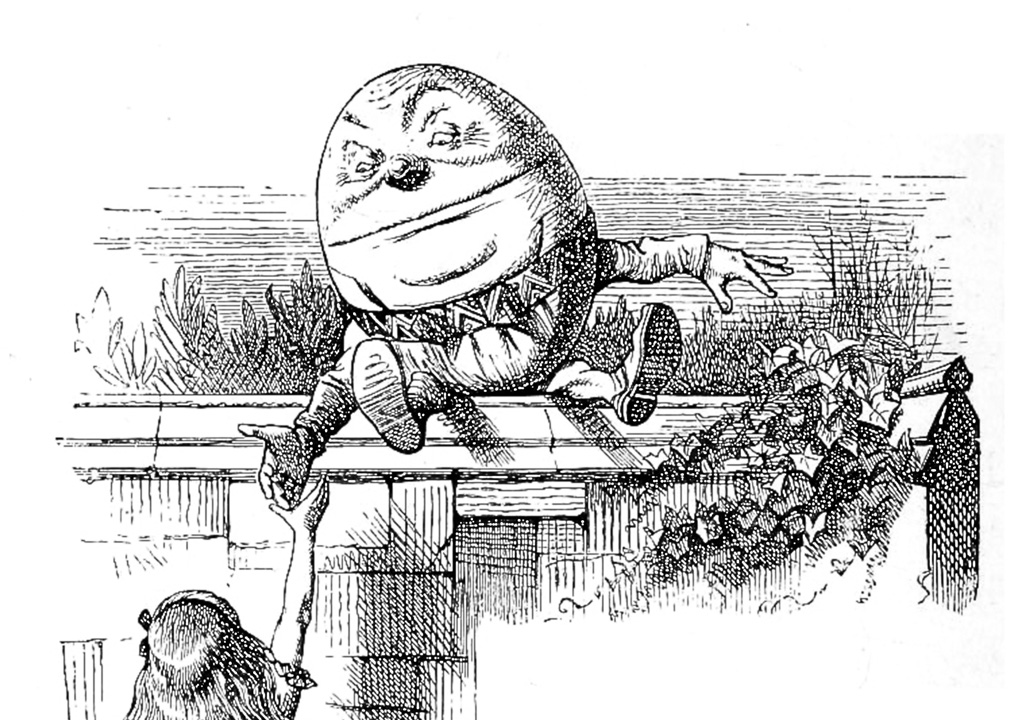
In December 1871 a London publisher brought out a sequel to a children’s book. In its sixth chapter a girl called Alice meets an egg sitting on a wall. The egg uses a word in a sense she has never heard, and she objects. He answers her calmly.
“When I use a word,” Humpty Dumpty said in rather a scornful tone, “it means just what I choose it to mean — neither more nor less.”
“The question is,” said Alice, “whether you can make words mean so many different things.”
“The question is,” said Humpty Dumpty, “which is to be master — that’s all.”
Children laughed at it, and still do. In the same year, on the other side of the Atlantic, a lawyer named Albert Pike published a thick handbook for the members of his order, which explained what its symbols meant, and to whom.
⬥
The Physician
The idea did not begin with the egg. It is set out, calmly and in full, in one of the most admired books on politics in the Western canon.
In Plato’s Republic, Socrates and his companions are designing an ideal city. Early on they agree that lying is generally harmful. Then they make an exception. Private citizens must never lie to their rulers, they decide, but the rulers may lie to the citizens, when it is for the good of the city. Socrates compares it to medicine: a lie in the hands of a ruler is like a drug in the hands of a physician, and only the physician may prescribe it.
He then prescribes one. The citizens are to be told that their upbringing was only a dream, and that they were really formed inside the earth. The god who made them mixed gold into those fit to rule, silver into their helpers, and iron and bronze into the farmers and craftsmen. Everyone, Socrates says, must be persuaded of this, the rulers included if possible. The tale has come down to us as the noble lie.
In Book V the physician increases the dose. The rulers, Socrates says, will need a considerable dose of falsehood and deceit for the good of their subjects. It is needed for marriages. The best are to be paired with the best, but nobody may know that this is being arranged. So the rulers will invent some ingenious kind of lots. The less worthy will draw them, and afterwards, in Jowett’s rendering, they will accuse their own ill-luck and not the rulers.
A rigged lottery, a ruler who deceives out of kindness, and a people who believe their lot is chance: it is all there, stated as policy. The book was not written in secret, and it is read in every university in the world.
⬥
The Words
The historian Thucydides watched the same machinery at work in a real city. In 427 BC civil war broke out on the island of Corcyra, and he recorded what it did to language before it did anything else. Words, he wrote, changed their ordinary meaning to suit the actions of those who used them. Reckless aggression was renamed loyal courage. Prudent hesitation was renamed cowardice in disguise. Moderation became a cover for weakness. The dictionary did not change. What changed was who decided what the words meant.
⬥
The Engineers
Twenty-four centuries later the idea returned. This time it came as professional advice rather than philosophy.
In 1922 the American journalist Walter Lippmann published Public Opinion. His argument was sober. The modern world is too large and too complex for ordinary citizens to grasp directly. They live among pictures in their heads, supplied to them by others. Consent to policy, therefore, cannot simply be waited for. It has to be produced. Lippmann gave that work its lasting name: the manufacture of consent.
Six years later a nephew of Sigmund Freud went further. Edward Bernays opened his book Propaganda (1928) by calling the deliberate manipulation of the public’s habits and opinions a normal and important part of democratic life. Those who operate this unseen machinery, he wrote, form an invisible government, and it is the true ruling power of the country. He did not intend it as a warning. He was describing his own profession, and offering its services.
On the organised shaping of public opinion, see Hypnosis in Advertising and Politics.
⬥
The Two Readings
In 1952 the philosopher Leo Strauss, then teaching in Chicago, published Persecution and the Art of Writing. He argued that many philosophers of the past had written on two levels at once. There was a surface teaching, suitable for the many and safe from the censor. Beneath it lay a second teaching, placed between the lines for the few who knew how to read it. The same page speaks to two audiences, and each takes away what it came for.
Strauss presented this as a discovery about old books. Whether it is also a description of newer ones, the reader may judge for himself.
⬥
The Inquisitor
In 1880 Fyodor Dostoevsky published The Brothers Karamazov. In one of its chapters a character tells a story he has invented. Christ returns to Seville at the height of the Inquisition. The old Grand Inquisitor has him arrested, and at night visits him in his cell.
The Inquisitor does not deny who his prisoner is. He explains to him, patiently, why he must be burned. Freedom, he says, was too heavy a gift for ordinary people. The Church has lovingly taken it from them and rules them now through miracle, mystery and authority. The few who know the truth carry its burden, so that the many may be happy. The prisoner says nothing at all.
Plato’s physician prescribes the lie. Lippmann’s experts manufacture the consent. Bernays’s invisible government operates the machinery, and the Inquisitor keeps the secret, out of love. In each case the few speak to the many, and in each case they speak in a language whose meaning they have decided themselves.
Humpty Dumpty said the only question was which is to be master.
When the same words are written for two readers, which of the two are you?
The Outer Court is a series in degrees. Previous: Everything here is a Gift. Next: The Lodge.
