

In January 1950, two mathematicians at the RAND Corporation in Santa Monica, Merrill Flood and Melvin Dresher, set a small trap for a large theory.
They had drawn up a payoff table. Two players, two choices each. Whatever the other man did, each player always did better for himself by choosing the selfish option. If both chose selfishly, both did worse than if both had held back. According to the new mathematics of strategic behaviour, rational players had only one destination: mutual defection.
Flood and Dresher doubted it. So that same afternoon they asked two colleagues to play. Armen Alchian, an economist from UCLA, and John Williams, head of RAND’s mathematics department. No story, no prison, no police. Just the table, and a hundred rounds.
The two men cooperated in sixty of the hundred games. Mutual defection, the outcome the theory called rational, occurred fourteen times.
The results were shown to John Nash, whose equilibrium the experiment had been designed to test. His objection is preserved in Flood’s report to RAND. The experiment, Nash wrote, was flawed: the players could not be treated as playing a hundred separate games. There was, in his words, “too much interaction.”
He also said what would have produced the correct result. Rotate the players, so that no one faced the same partner twice. Give no one any information about what the others had chosen until all the trials were over. Under those conditions, he expected, the outcome would have been quite different.
Read the remedy slowly. It is not a refinement of the experiment. It is a floor plan.
The Walls Go Up
Nash was not proposing a policy. He was defending a theorem, which is what mathematicians do. But his correction contains, with complete precision, every condition the previous article in this series identified as essential to the dilemma.
No repeated partner. No memory between rounds. No knowledge of what anyone else is doing. Each man alone with his table.
A few months later, Albert Tucker, Nash’s own doctoral adviser, needed a way to explain the game to an audience of psychologists at Stanford. Flood and Dresher’s dry payoff table would not hold a lecture hall. So Tucker invented a story: two suspects, arrested together, held apart, each offered a bargain by the authorities. It was this story that gave the game its name. In the version that became standard, the two men sit in separate cells with no means of speaking to each other.
The first two men to play the game sat in the same building, saw each other’s moves after every round, and learned to trust each other within an afternoon. The prisoners who replaced them in every textbook since were given a cell each.
The room was not part of the original game. It was added afterwards, by the people explaining it.
The Same Year, Another Building
In 1950, Harper & Brothers in New York published a book of nearly a thousand pages called The Authoritarian Personality. Its lead author was Theodor W. Adorno, of the Institute for Social Research, the Frankfurt institute that had relocated to the United States in the 1930s. His co-authors were the Berkeley psychologists Else Frenkel-Brunswik, Daniel Levinson and Nevitt Sanford.
The book’s centrepiece was a questionnaire called the F-scale. The F stood for fascism. Its purpose was to measure, in ordinary American citizens, a personality’s receptivity to fascism before any politics had appeared on the surface.
Respondents were asked how strongly they agreed with thirty statements. One of them read: “Obedience and respect for authority are the most important virtues children should learn.” Another held that hardly anyone could be lower than a person who lacked love, gratitude and respect for his parents. Agreement raised your score. Other items probed attachment to convention, to one’s own group, to established moral standards.
Set this list beside the hundred rounds in Santa Monica. What made Alchian and Williams cooperate was a known partner, a shared history, an expectation of meeting again, a standard of conduct each could rely on in the other. Loyalty. Memory. Reputation. The things that dissolve the prisoner’s dilemma are, almost item for item, the things the F-scale was built to record as symptoms.
In one building in 1950, the bonds between players were a flaw in the experiment. In another, the bonds between people were a flaw in the personality.
The method did not go unchallenged. In 1954, a volume edited by Richard Christie and Marie Jahoda assembled the criticism. The sociologist Edward Shils argued that the study had placed authoritarianism on the political right only, when the extremes of left and right shared much of the same character. Other researchers pointed to a simpler problem: every item on the scale was worded so that agreement counted as authoritarian. A respondent inclined to agree with statements in general, whatever their content, would score as a proto-fascist. The instrument could not easily produce any other answer.
The criticism remained in the journals. The concept left them.
The Book Before the Book
Adorno’s thinking had a longer root. In May 1944, he and Max Horkheimer completed a manuscript in American exile titled Philosophische Fragmente. That December it circulated as a mimeographed typescript, a few hundred copies, among the institute’s associates. In 1947 it was published by Querido in Amsterdam under the name by which it is now taught in every faculty of the humanities: Dialektik der Aufklärung.
1944 is the year von Neumann and Morgenstern published the mathematics of games, and the year Hesse published Das Glasperlenspiel. Three projects to explain how human beings think and choose, finished in the same year. One became literature. One became the operating system of strategy. The third became the grammar in which the next generation would learn to suspect its own inheritance.
Marcuse Says It Plainly
Herbert Marcuse, Adorno’s colleague from the same institute, did not leave his conclusions to inference.
In 1965 he published an essay titled “Repressive Tolerance” in a small Boston volume, A Critique of Pure Tolerance. His argument was that tolerance extended equally to all views had become an instrument of repression in what he called the administered society. The remedy was a different tolerance, partisan rather than neutral, which he named “liberating.” He spelled out what it would mean: “intolerance against movements from the Right and toleration of movements from the Left.”
He did not describe this as an excess to be guarded against. He described it as the goal. Elsewhere in the same essay he extended the withdrawal of tolerance beyond deeds to thought, opinion and word.
In the language of the game: one side keeps its seat at the table. The other is moved to a separate room and denied the means of speaking. The player who is not permitted to communicate cannot coordinate. The player who cannot coordinate defects, or is defeated. The mathematics had already established what happens next.
The Apprentice
The students read all of it.
On the last day of January 1969, Hans-Jürgen Krahl, one of Adorno’s own doctoral students and the leading theorist of the student movement in Frankfurt, led a group into the Institute for Social Research to occupy it. Adorno, its director, called the police. Seventy-six students were arrested. As Krahl was led through the police cordon, he shouted at his professors an insult that turned the name of their own school into an obscenity.
The institute had been tolerant, in the old sense, for years. Now it was being judged by the newer sense.
In April 1969, Adorno began his lecture course “Introduction to Dialectical Thinking.” Students interrupted him. One wrote a mocking rhyme on the blackboard: whoever lets dear Adorno have his way will preserve capitalism for the rest of his life. Adorno cancelled the series. Jürgen Habermas, his former research assistant, had already given a name to the radicalised activism of some students: a form of left-wing fascism.
In May, Der Spiegel published an interview with Adorno. Asked whether he still believed in the power of theory, he said he had no fear of the ivory tower. Around the same time, according to the historian Martin Jay, he remarked that when he had built his theoretical model, he could not have guessed that people would try to carry it out with Molotov cocktails.
He died that August in Switzerland. He was sixty-five.
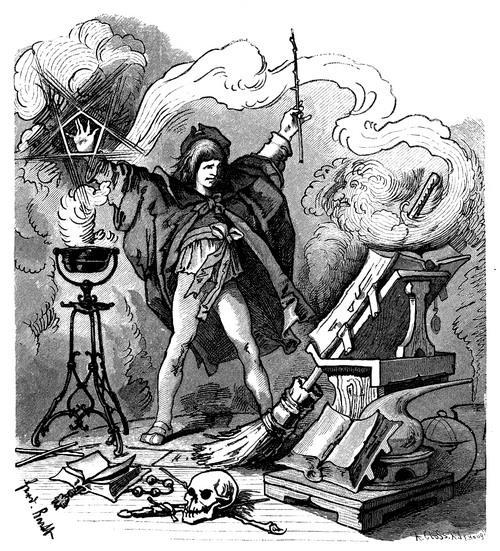
In 1797, Goethe published a ballad about an apprentice who, while his master is away, speaks a spell he has overheard. The broom fetches water. It does not stop. He splits it in two with an axe, and now there are two brooms. In the end he cries out:
Herr, die Not ist groß! Die ich rief, die Geister, werd ich nun nicht los.
The spirits that I called, I cannot now be rid of.
Human Action, Not Human Design
In 1767, the Scottish philosopher Adam Ferguson observed that nations stumble upon institutions that are the result of human action, but not the execution of any human design. Nobody plans a language. Nobody plans a market. The order emerges, and no one who took part in making it can see the whole.
Ferguson’s sentence is usually read as a comfort. Here it reads both ways.
Each piece of the room was built by someone, on purpose, for a reason. A mathematician wanted his theorem to hold, so the players were rotated and blinded. A lecturer needed his audience to understand, so the players were put in separate cells. A psychologist wanted to detect fascism before it spoke, so loyalty and reverence were scored as warning signs. A philosopher wanted liberation, so tolerance was taken from one side of the table.
Every piece was designed. The whole was not. Its builders could not stop it once it began to move, and at least one of them watched it turn on its maker.
Today the rotation of partners and the withholding of information no longer require an experimenter.
A Question for the Afternoon
The previous article asked who benefits from keeping the rooms separate. The record answers a narrower question: who drew the walls. The wider one remains open, and that is perhaps the right place for it.
But consider what the record also shows. On a single afternoon in January 1950, two men with no story, no shared ideology and nothing to gain but points in a table found their way to cooperation in sixty rounds out of a hundred. They needed no theory to do it. They needed only to be able to see each other, and to know they would play again.
The mathematicians called that a flaw. It is the oldest thing the game contains.
If cooperation returned within an afternoon to two strangers who could see each other, what did the free men beyond the Rhine know about this, long before anyone needed to build a room to prevent it?
The next article in this series: The Answer They Already Had.
Previously in this series: Two Prisoners.
Related reading: The Machinery of Nobody’s Fault.
