
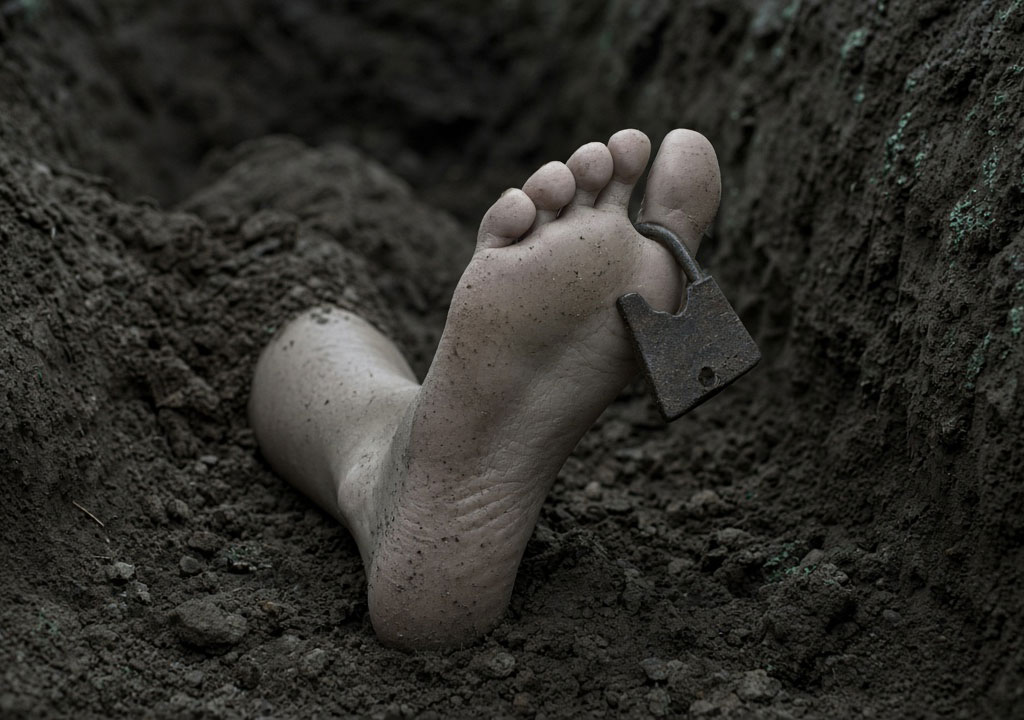
In 2022, archaeologists from the Copernicus University at Thorn lifted a small triangular padlock from the left big toe of a young woman in Grave 75. It had been fastened there in the middle of the seventeenth century. When it came out of the earth, it was open.
The grave lies in an unmarked field outside Pien, a village in the old Kreis Culm in West Prussia. The team had been digging there, on and off, since 2005, and they knew the field was a strange one. Across her throat lay an iron sickle, its blade turned in toward her neck.
The record does not say how the lock came open. Rust can do it, and so can the slow weight of earth. Everything else about her, the record tells in order, one precaution at a time, and each one is stronger than the last.
⬥
The first lock
The padlock went on at the first burial, before the earth went back in. Dariusz Poliński, who leads the excavation, reads several meanings into it at once. It closed an earthly life. It cut the ties between the dead and the living. It barred the way back. In some traditions such a lock was even believed to halt an epidemic.
Behind the lock stood an older belief, which Oscar Nilsson, the forensic sculptor who later gave her back a face, has set down. A dangerous person was thought to carry two souls, one good and one bad. A locked padlock held the good soul inside the body. Should the lock fail, the bad soul was free to take over, and a strzyga could rise from the grave.
There was a second precaution, quieter than the first. A green stain spreads across her palate and into the nasal cavity, down to the base of the skull and the first two vertebrae of the neck. Something rich in copper was placed in her mouth or nose as she was buried. It was not a coin; the stain is far too wide, and the traces of copper, gold and manganese do not match the alloys of the period. What it was, nobody can yet say.
In the folklore of that country, copper kept the strzyga away, the dead who will not stay dead. Lock and copper together should have been enough. They were not.
⬥
Not enough
Not long after the burial, someone came back to the field and dug down to her again. The layers of soil record it. Her bones lay in their proper order, joint against joint, which means the flesh was still holding her together when they reached her.
They laid an iron sickle across her throat, thirty-six centimetres long, the blade turned toward her neck. The belief behind it was simple and exact: should she rise, the blade would open her throat or take her head. Its wooden handle was most likely birch, alder or maple, and birch was itself counted a guard against demons and witchcraft.
Poliński thinks a fresh misfortune, perhaps another death, sent them back. Nilsson pictures one more moment. The villagers dig down to her, and find the padlock already open. Then, in panic, they lay the blade across her neck. The record cannot prove that moment. It cannot rule it out either. Whoever came knew exactly where she lay. A village does not dig up one of its dead in a hurry. Something between the first burial and the second had frightened it badly.
⬥
A girl apart
Around her jaw lay the remains of a woven band from a silk cap. Four threads along its edges were pure silver and pure gold. No servant was buried in that. The researchers place her in the upper ranks of society, perhaps the nobility.
She was between seventeen and nineteen, of ordinary height for her day. Her bones carry no wound and no sign of what killed her. They carry the marks of a hard life instead. Lines across her shinbones record a childhood of hunger, injury or sickness. A tumour in her breastbone may have shown as a red mark on her chest, or as a large swelling. At the top of her spine sits a malformation known as Kimmerle’s anomaly, which can bring on violent headaches and sudden fainting fits. A girl who fell down without warning, in a village that believed in two souls, would not have been looked at the way other girls were.
Her mother’s line may have come from the north. The DNA that passes only from mother to daughter points, among several possibilities, toward Scandinavian stock, though that sequence is common enough across Europe to prove little. Her teeth are plainer. The strontium and oxygen in them say she grew up in the country around Pien. Whatever she was, she was the village’s own. Yet Nilsson reads her colouring as pointing toward southern Sweden, and in her century Swedish armies had fought across Royal Prussia. Swedes, he notes drily, were not popular.
⬥
What the village feared
The word vampire came into common use only in the century after hers. In her own time the category was the demonic, and it was a wide net. It could take in outsiders, heretics and orphans, the drowned and the self-slain, and women who died in childbirth. To be different, or to die strangely, could be enough.
Poliński has offered one hypothesis more often than the others. The village, he suggests, may have feared her revenge. Something may have happened in her life; she may have been harmed. Her neighbours may have treated her badly while she lived, and then feared that she would come back for them. One fears the revenge of the dead only for what was done to them alive.
She was not the only one. Of the 101 graves opened in the field, more than a dozen are out of the ordinary. A boy lay face down with the same kind of triangular padlock at his right foot; later his grave too was opened and most of him taken away, leaving only the lower legs and feet. Other dead were weighed down with stones. The field lay outside consecrated ground, the place a parish kept for its poor and its disgraced. To this day nobody in Pien builds on the hill, and children are taught to keep away from it.
In the same century, the German towns farther west kept their fears in court ledgers, as Paid by the Case recorded.
⬥
She looks back
In 2024, in his Stockholm studio, Nilsson rebuilt her face on a printed copy of her skull, muscle by muscle in clay. The DNA gave him fair hair and blue eyes. A seamstress dressed her for her rank, a ribbon on a silk bonnet. He said he wanted to bring her back as a human being rather than a monster, and he noted the irony himself: her own village did everything in its power to keep her in the ground, and the modern world has done everything in its power to bring her back.
The bones dictated the face. One last choice they could not dictate, and Nilsson made it himself: she is shown looking back over her shoulder.
What Pien feared most has come to pass. She has returned, not through the soil but through clay and silicone, and her face has gone around the world, admired by people who never stopped to ask what the padlock was for.
The padlock on her toe was meant to hold one thing in place. Someone turned the key on a girl of good family whom the village had already set apart, and then came back with iron when the key did not seem enough. Nearly four centuries later the lock lay open in the soil, and the people who closed it had left no names at all.
Who was afraid of the girl in Grave 75?
Her face hangs in Nilsson’s own gallery.
Sources
Dariusz Poliński et al., Journal of Archaeological Science: Reports, published 30 July 2026.
Copernicus University, Thorn: New Face of the Vampire Woman
Oscar D. Nilsson: Zosia from Pien, Poland
Smithsonian Magazine: Why Was This 17th-Century Polish Woman Buried With a Padlock on Her Toe and an Iron Sickle Across Her Neck?
Science News: This ‘anti-vampiric’ grave used two strategies to stop the undead
Science in Poland (PAP): ‘Vampire’ grave mystery deepens as 17th-century woman ‘may have been an outsider’
Notes from Poland, 28 August 2026: Polish ‘vampire’ burial sheds light on 17th-century efforts to keep the dead in their graves
Daily Galaxy (the reconstruction’s pose and clothing): Scientists Rebuild Face of ‘Vampire’ Woman Buried 400 Years Ago
PBS, Secrets of the Dead: A Gruesome Discovery in Rural Poland
Kreis Culm: Gemeindeverzeichnis, status 1 January 1908; census of 1 December 1871
