
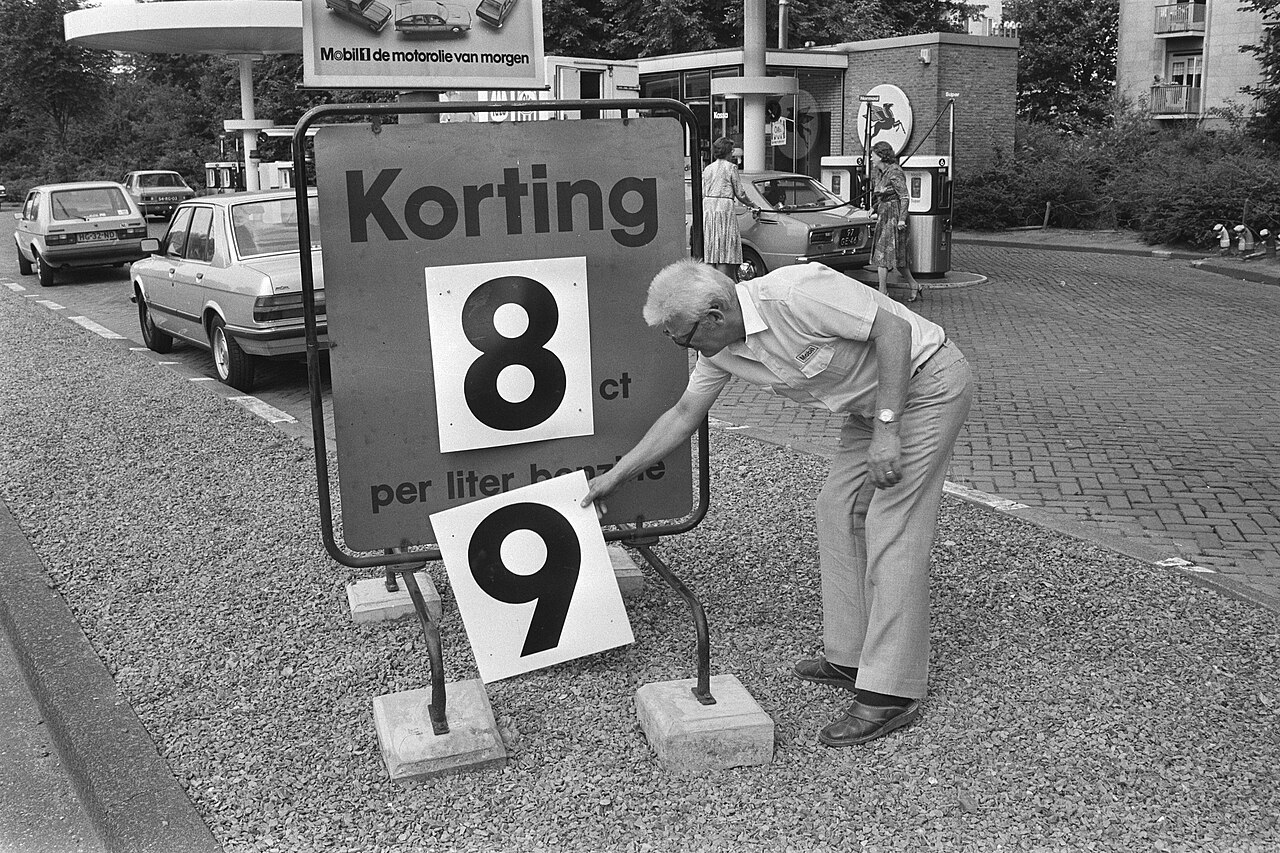
On 1 May 2026, the German federal government lowered the excise duty on diesel and petrol by 14.04 cents per liter, citing the high fuel costs that had followed the outbreak of the war involving Iran. The reduction expired on 30 June 2026, on schedule, and the excise returned to its previous level. Two months of relief, tied explicitly to a war, ended not when the war ended, but when the calendar said so.
That detail is worth sitting with, because it is the cleanest evidence available that the two things people are told about the pump price — the geopolitics and the tax — are not the same thing, do not move for the same reasons, and are almost never separated when a minister explains why filling a tank costs what it costs.
What Belongs to the Barrel
Some of it is genuinely not anyone’s domestic doing. Brent crude has traded around $107 to $109 a barrel through the first half of September 2026, up sharply after Saudi Arabia shut its East-West pipeline following drone attacks, with talks on a temporary shipping corridor through the Strait of Hormuz stalled. A barrel holds 158.987 liters; at that price and the euro-dollar rate of the day, the raw crude behind a liter of fuel works out to roughly 58 to 59 cents — before refining, before transport, before anyone’s margin.
Refining itself is the sharper story. The “3-2-1 crack spread” — the standard measure of what a refinery earns turning three barrels of crude into two of petrol and one of diesel — has been at levels rarely seen outside a genuine shortage. Diesel refining margins at the Amsterdam-Rotterdam-Antwerp hub hit $85.86 a barrel in late July 2026; the US diesel crack spread set an intraday record of $108.02 a barrel on 3 September. The International Energy Agency attributes this to three things arriving together: the Hormuz conflict removing roughly 13 percent of global oil supply, drone strikes and sanctions knocking out an estimated quarter of Russia’s refining capacity, and winter distillate demand landing on inventories that were already thin. None of that is invented for a press conference. It is a real, measurable, currently-unfolding refining crisis, and it explains why diesel in particular has been expensive to make.
What Belongs to No One in Particular
Underneath that volatile layer sits a second one that does not move with any of it.
In Germany, the fuel excise is a fixed 65.45 cents per liter of petrol and 47.04 cents for diesel, plus a national carbon levy running roughly 16 to 19 cents depending on the fuel, plus 19 percent VAT charged on the total — including the excise and the carbon levy, a tax calculated on top of a tax. The German motoring association ADAC put the combined tax share of the pump price at about 57 percent for petrol and 47 percent for diesel in July 2026. In Belgium, the federation representing the petroleum sector reported that excise and VAT together made up 55 percent of the maximum petrol price and 53 percent of diesel, as of 31 December 2025. Across the EU as a whole, tax accounted for 52.1 percent of the petrol price and 44.6 percent of the diesel price in mid-March 2026, according to the European Commission’s own Weekly Oil Bulletin.
None of these numbers moved when Brent went from roughly $90 to $108 a barrel this summer. They do not move when a pipeline in Saudi Arabia is attacked. They are set once, in a budget line, and they stay there regardless of what a barrel of crude is doing on any given Tuesday — with the sole exception, in Germany’s case, of two calendar months in the middle of the crisis it was named after.
The breakdown above exists for exactly three countries — the Netherlands, Belgium, and Germany — because those are the three where a national statistics office, a motoring association, or a sector federation publishes the itemized split in public, dated documents. Most EU member states do not. The pump price is published. The tax rate is published. The subtraction is left to the driver, if the driver thinks to do it.
Put a real, dated comparison next to it. On 10 August 2026, the European Commission’s Weekly Oil Bulletin recorded diesel at €2.323 per liter in the Netherlands, €2.157 in Belgium, and €2.149 in Germany. The Dutch government, asked about the gap in parliament, confirmed that the excise difference does not explain it — Belgium’s diesel excise runs only about 8 cents higher than the Dutch rate, not 17. Splitting each of those three prices into its excise-and-VAT component and everything else — crude, refining, transport, distribution, company margin — produces a state take of roughly 96 cents in the Netherlands, just over a euro in Belgium, and just over a euro in Germany, out of totals a little above two euros each. In every case, the government’s share and the industry’s share come out close to the same size. Only one of the two is ever named on the evening news.
Consider what each side of that split had to do to earn its euro. The industry’s share paid for a barrel pulled from the ground or the seabed, shipped, refined under conditions currently tight enough to set records, trucked to a station, and sold by someone standing behind a till. The government’s share required none of that — no barrel, no refinery, no tanker, no risk that a shipment fails to arrive. It required a rate, set once a year, in a document almost no driver has read. The two sides arrive at the pump roughly the same size. Only one of them had to build or move anything to get there.
The Diesel Question
There is a genuine irony sitting inside this. Diesel is taxed lower than petrol in every country checked here — a political choice made decades ago to favor commercial transport, still on the books, still structurally the case. And yet diesel has recently traded level with or above petrol at the pump, because the refining side, not the tax side, is where the current shortage lives. Governments can point at that shortage and be entirely correct that they did not cause it. The same governments rarely volunteer that the other half of the price — the half they set themselves, in cents per liter, once a year — costs the driver about as much as the shortage does, and has for years.
The lower fuel excise is not the only place diesel is taxed differently, either. Germany’s vehicle tax law sets the annual rate at €9.50 per 100 cubic centimeters of engine displacement for a diesel car, against €2.00 for petrol — a gap written directly into §9 of the Kraftfahrzeugsteuergesetz and described there, without euphemism, as compensation (Ausgleich) for the lower fuel excise diesel drivers pay at the pump. Belgium restructured its vehicle registration tax on environmental criteria in 2012, and diesel cars have paid a separate CO2-based surcharge at registration — worth up to a couple hundred euros in Flanders — ever since. The Netherlands charges a standing “diesel surcharge” on its ordinary road tax, applied to every diesel car regardless of how clean its engine is, on top of a second, narrower levy — the “fine-particulate surcharge” — that applies only to diesels emitting above a set threshold, mostly older or unfiltered models. One of those two Dutch charges tracks pollution. The other tracks fuel type. The lower price at the pump and the higher bill in the mailbox are not, on this evidence, two policies arrived at by two separate logics. They are the same fiscal position, collected twice, through two tax codes that rarely appear in the same sentence.
⬥
A household budget works the same way when a bill arrives with two line items stapled together and only one of them explained. The part that moves gets a headline. The part that doesn’t gets silence — not because it is hidden, but because nobody in the room benefits from being the one who reads it aloud.
The next time a minister explains a fuel price by pointing at a war, two questions are worth asking rather than one. First: fine, and the other half of the liter — the half with your government’s name on the invoice — what moved that, and when was it last allowed to move down? Second, for whichever official insists the price is simply what a free market sets: if the single largest line item at the pump is fixed once a year by decree, with no competing supplier and no negotiation available to the buyer, is that still the market they mean?
