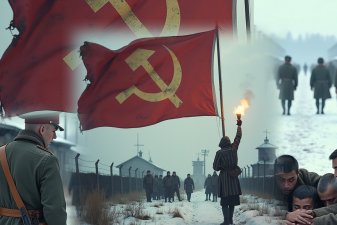
Part II of the series “Verrat an der Ostfront — The Lost Victory 1941–42” When the divisions of the Wehrmacht crossed the frontier on 22 June 1941, they carried with them not only the weight of an immense military gamble, but the burden of errors that were no accidents and oversights that defy simple explanation. The first weeks of Barbarossa have often been described as a triumph of...
War
This category contains everything on the topic war in general, all related to the Maier files series. Articles are short and relevant concerning war and warfare especially the two recent World Wars.
Part I of the series “Verrat an der Ostfront — The Lost Victory 1941–42” History often hides its deepest fractures behind the noise of marching armies. From a distance, nations appear unified, purposeful, moving like singular organisms toward their fate. Yet, as Friedrich Georg’s Verrat an der Ostfront reveals with quiet, merciless precision, the Germany that prepared for the great struggle in the East was no such organism....
The North Sea hides more than wrecks. It hides intentions. Its waters turn black under cloud, its cliffs crumble and reform, and every tide washes up the same ancient gift — a piece of amber, a drop of sun turned to stone. Amber was never just a gemstone. For centuries it was called the tears of the gods, a hardened memory. To hold it was to feel the...
In 1945, three “smoking guns” set the stage for the quiet removal, redistribution, and even destruction of Germany’s most advanced research. This detective-style dive follows the paper trail—from Truman’s license-to-steal order to a midnight conference in Frankfurt and a vanished hilltop lab—to reveal how electromagnetic and communications breakthroughs could simply disappear. Background reading that reframes what might have happened to any inventor who got too close. If you...
One finds, in the briefcase of modern war, plans of such chilling clinicality that they mock the old notions of battle—the clash of armies, the siege of fortresses, the duel of honor and strategy. The events which overtook the German city of Hamburg in the summer of 1943 were of an altogether different character, belonging to that new and terrible species of warfare in which entire civilian populations...
The chaotic failure of the German response on D-Day was not an isolated event. As Friedrich Georg meticulously documents in Verrat in der Normandie, it was the opening act of a broader, more sinister drama that unfolded across the summer of 1944. The pattern that emerged was one of such consistent and catastrophic failure that it defies any explanation other than deliberate sabotage from within the highest echelons...
The story of D-Day, as taught for decades, is a stirring tale of Allied courage and ingenuity. It is a narrative of the brave boys storming the forbidding Atlantic Wall, overcoming fierce German resistance through sheer grit and overwhelming material strength. It is a comforting story, simple in its moral binary. But like so much of history, the comforting story is often a veil drawn over a far...
The curtain fell on the Second World War in May 1945, leaving a continent in ashes and a nation utterly broken. The German Reich lay prostrate, its cities reduced to landscapes of rubble and despair. In Berlin alone, 180,000 of 250,000 buildings were destroyed. Across the battered nation, over five million homes were uninhabitable. From the skeletal remains of these ruins, 2.8 million Berliners emerged, eking out a...
In the shadows of history’s pages lies a tragedy of immense proportions – one deliberately obscured from worldwide consciousness. While much has been written about the crimes committed by Germans during World War II, a deafening silence surrounds the crimes committed against Germans. This silence must be broken. The Systematic Expulsion: A Crime Against Humanity In the final days of World War II and primarily after Germany’s capitulation...
When we think of WWII, the images are often stark, chilling, and well-documented: battles fought on bloodied soil, cities reduced to rubble, and the unyielding resilience of a world enduring turmoil. Yet, as historian Miriam Gebhardt’s Als die Soldaten kamen (When the Soldiers Came) shows us, an even darker narrative lurks behind these well-documented horrors—one that mainstream history has largely ignored. This harrowing account dives deep into the...
In 1918: The Gateway to Hell – The Hidden Truth About the Downfall of the German Empire, Dr. Thomas Jung and Friedrich Georg uncover a narrative often omitted from mainstream accounts. The book dives deeply into the intricate forces at play that led to the German Empire’s collapse, including strategic missteps, underhanded deals, and the pervasive impact of foreign interventions. What makes this book particularly compelling is its...
In The Women Who Flew for Hitler, Clare Mulley unveils the intertwined yet contrasting lives of Hanna Reitsch and Melitta von Stauffenberg, two of Nazi Germany’s female test pilots. These two women, while sharing a passion for flying and a commitment to their country, could not have been more different in their views and moral convictions. Mulley’s book is a thrilling exploration of ambition, loyalty, and the ethical...