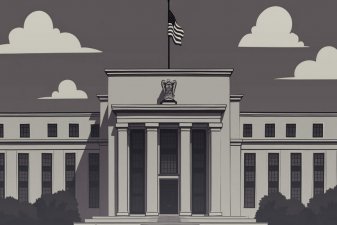
Richard Cantillon was an Irish-French banker who understood something important about new money — early enough to become very wealthy from it, and precisely enough to write it down afterward. In 1720, John Law’s Mississippi Company was the most spectacular financial enterprise in Europe. The French state, drowning in debt, had authorised Law to print paper money, sell company shares, and promise investors extraordinary returns from colonial trade. Shares rose....
Operation Golden Lily, a peer of the British Parliament, and the gold that exceeded all the gold in the world This is the third article in the Off-Books Capital series. The first established the infrastructure through which capital that officially does not exist can be made to arrive. The second established the diagnostic tool — Milton Friedman’s long and variable lag — that allows its effects to be seen in...
Inflate a balloon. More air enters. The balloon grows. Each breath shares the space with every breath before it. More. Bigger. Each unit inside: worth a little less than before. The Romans did it with coins — shaving the edges, adding cheaper metals, more coins in circulation. Medieval merchants did it with grain — more grains in the bucket, each grain buys less at the market. Every trading civilisation that used seashells as currency eventually discovered the beach. Inflate. The […]...
Every good magic show has a mechanics problem. The trick works because the audience looks where it is directed. The hand that matters is never the hand being watched. This is not a secret — it is the operating principle, built into every performance. What follows is a look at the other hand. Not the amateur kind of sleight of hand. The sovereign kind. The Small Version Somewhere in your...
In May 2026, the World Health Organisation issued warnings about Hantavirus. The language was urgent. The coverage was immediate. Moderna’s stock rose before a single dose of anything existed — before a trial, before a formulation, before a confirmed outbreak of any scale. The market moved on the announcement alone. The Hantavirus emergency failed to materialise at the predicted scale. Within days, the WHO pivoted to Ebola. The sequence is...
There is a thread running through the last hundred years of German monetary history. Pull it gently and four documented facts come loose — separated by decades, connected by a pattern that no one has satisfactorily explained. 1928 Hjalmar Schacht, president of the Reichsbank, travels to New York to inspect German gold held at the Federal Reserve. He is taken to the vault. The custodians cannot locate the bars they claim to be holding on Germany’s behalf. Schacht records what […]...
In October 1998, a few months after its founding, the European Central Bank announced its definition of price stability. The Maastricht Treaty — the founding document that called the ECB into existence — had instructed the Bank to maintain price stability across the eurozone. A reasonable mandate. The meaning of stability is not difficult to find in a dictionary: the condition of being unlikely to change; the absence of significant...
On March 11, 2026, the Deutsche Finanzagentur brought €5 billion in 10-year Bunds to market. It was a routine operation in a routine year. Yet, when the bidding closed, the market had signaled a departure from the script: only €3.8 billion was allocated. The official terminology calls this a ‘technical failure’—a glitch in the machinery of issuance. But for those who look past the yield curves and the ECB’s shadow,...
It is rather like entering a cinema midway through a grand drama. The screen flickers with the ruins of once-vibrant cities—Berlin’s spires shadowed, Paris’s boulevards hushed, London’s markets subdued. Families drift apart like leaves in a chill wind. Nations murmur of “community care” from distant chambers in Brussels, their ancient borders softening into mist. Births grow scarce, traditions fade. One pauses, puzzled: What finale is this? Who might have shaped such a script? Perhaps a quiet rewind, peering back through […]...
In 1998, at a cold fusion conference, electrochemist Martin Fleischmann made a curious statement. After discussing the technical challenges of replicating cold fusion results, he paused and offered something more unsettling: “There are all sorts of other phenomena which we really can only interpret in terms of quantum field theory, and then there is this enormous question: if we think about condensed matter physics and chemistry, biology, even in terms...
© Nils Thies
Yesterday, fresh voices in Germany—economists, FDP politician Marie-Agnes Strack-Zimmermann, and others—urged the Bundesbank to bring home the remaining 1,236 tons of gold (valued at around €164 billion) still stored in the Federal Reserve Bank of New York. The reason cited? Donald Trump’s return to power and his “unpredictability,” making reliance on U.S. vaults too great a geopolitical risk in uncertain times.This is not new. It is, in fact, entirely predictable.Back...
Let’s have a quiet chat about a story from Sweden. It’s not dominating the headlines, but it speaks volumes about the world we live in. An economist named Christian Steinbeck, writing in the journal Kvartal, has published a report on the country’s massive investment in wind power. The findings, detailed by Fria Tider, are a case study in modern finance. Sweden has spent over 300 billion Kronor—roughly 30 billion euros—to erect some 6,000 wind turbines. The initial motive was clean […]...

Categories

Maier files books