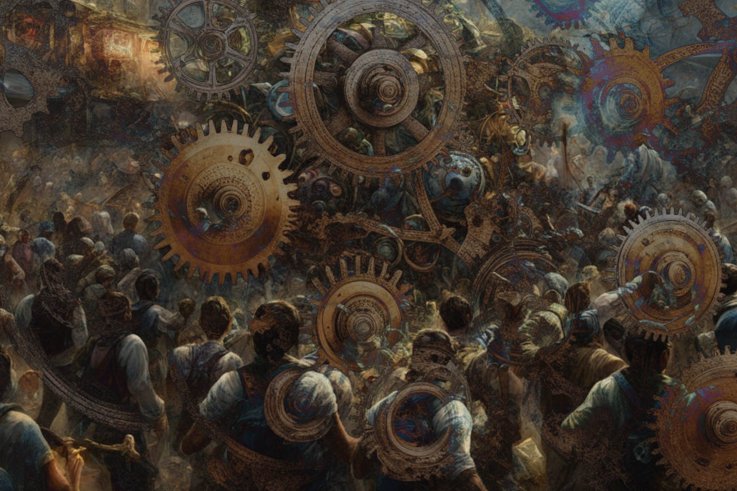
By Friedrich Lenkeit, Guest Contributor to Maier Files Tidbits Thank you for allowing me to return to these pages. My previous reflection on remembrance and Veterans Day came from the heart, but today I wish to speak from the mind—to analyze a silent war being waged not in the streets, but in the very architecture of human thought itself. From Academic Theory to a Blueprint for Control I have spent...
“What if the battlefield was no longer land or ideology — but the human nervous system itself?” When most people hear the term mind control, they envision the tropes of bad thrillers: hypnotic spirals, CIA brainwashing labs, and cult leaders whispering strange mantras. But the true story, as Heiner Gehring presents it in Versklavte Gehirne (“Enslaved Minds”), is far more disquieting — and far more real. In the mid-20th century,...
Carl Jung, in his chapter “The Soul and Death” from Psychology and the Occult, offers a deeply contemplative examination of the inevitable intersection between life and death, urging us to reconcile these forces as part of a continuous psychological process. Unlike the typical view that death marks a strict endpoint, Jung expands on the notion that death serves a psychological and even transformative role for the human soul, urging us to prepare not only for life but for its cessation […]...
C.G. Jung’s seminars on Nietzsche’s Thus Spake Zarathustra, held between 1934 and 1939, are a monumental exploration into the depths of Nietzsche’s philosophy through the lens of analytical psychology. Jung was profoundly influenced by Nietzsche, and in these seminars, he delved into the psychological underpinnings of Nietzsche’s work, examining it from the perspective of the collective unconscious and archetypal symbolism. Jung saw Zarathustra as an essential text for understanding the...
Carl Gustav Jung’s The Undiscovered Self offers a profound exploration into the psychological struggles of modern individuals, particularly within the context of mass-mindedness and societal structures. This short but impactful book delves into the consequences of losing personal identity in the face of collective movements and ideologies, touching on themes that resonate strongly in today’s world. As the fabric of our society becomes ever more dominated by political movements, technological...
The Intersection of Physics and Psychology: Unraveling the Mysteries of Matter, Energy, and the Mind
In Arthur I. Miller’s Deciphering the Cosmic Number: The Strange Friendship of Wolfgang Pauli and Carl Jung, we are introduced to a profound and intellectually stimulating discourse that explores the intersection of quantum physics and psychology. Through the lens of Wolfgang Pauli, a pioneering physicist, and Carl Jung, the father of analytical psychology, Miller delves into the complex relationship between matter, energy, and the psyche. The exploration of these concepts, particularly through the riddle of the electron, offers us a […]...
Initiation—an evocative term that conjures images of secret rites and profound transformations—has intrigued anthropologists and scholars of religion for generations. As Joseph Henderson wisely noted in his seminal work, Thresholds of Initiation, “Initiation more than any other body of knowledge has suffered throughout history from the fate of continually being forgotten and having to be rediscovered” (Henderson 2005: 1). In 1909, a remarkable resurgence of interest in initiation rites occurred,...
Subversion, as a concept, involves the deliberate effort to undermine or destabilize established institutions, authorities, or societal structures. It is often carried out through covert or manipulative means, aiming to erode trust in institutions, demoralize populations, and foster discontent. In the context of the Western world, subversion has taken various forms, and its impact on trust in institutions and contempt for established power can be attributed to several key mechanisms....
In the realm of myth and music, the story of Tristan und Isolde holds a profound place, delving into the mystique of love and death. This article explores the deeper, perhaps occult, significance of the Tristan und Isolde myth, using insights from Denis de Rougemont’s “L’amour et l’Occident” and Robert A. Johnson’s “Die Traumvorstellung Liebe – Der Irrtum des Abendlandes.” By examining Richard Wagner’s music drama, we unravel the layers of Tristan’s quest for his Anima, the elixir of love […]...
The problem of evil is a perennial one. Theodicies abound throughout history, explaining God’s purposes in tolerating evil and allowing it to exist. Mythological and theological dualisms try to explain evil by asserting its metaphysical status and grounding and the eternal conflict between evil and good. More psychological theories locate evil in humanity and in psychopathology. Probably humans have forever wrestled with questions like these: Who is responsible for evil?...
Compared to other social scientists, it appears that social psychologists appear to be especially concerned about the negative effects of rebels in groups. For example, sociologists often point to the important function that deviance plays in group life and the beneficial effects of deviance. Emile Durkheim (1958) highlighted that deviance and crime are important activities within any healthy society. He argued that, in the process of responding to deviance, group...
Hypnosis, suggestions can drastically alter the way individuals perceive and think about their world. There has always been tension between the rulers and the ruled, the masters and the masses. It is the centrifugal pull of self-desire against the welfare of the larger society, the tether that holds human history together. For much of that history society at large was the concern of a governing class: kings or priests, who often viewed the masses, scrabbling for survival, with disdain. As […]...